SPSpeedPrepHelp · Methods

Every shortcut, and when it wins.

Each SpeedPrep question asks for the fastest next step. "Fastest" means a named method that teachers around the world use. If a method fits the board, its step is the answer. If none fits, the normal textbook step is the answer.

Below is every method in the game, with worked examples and videos that teach it. Something look wrong? Each method has a feedback form, and we read every one.

84methods458video lessons8topics

How a step is scored

No method matches that search. Try a simpler word, like "round" or "percent".

Add & Subtract

Shortcuts for adding and taking away: make round numbers, then the rest is easy. 14 methods

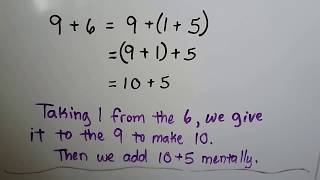
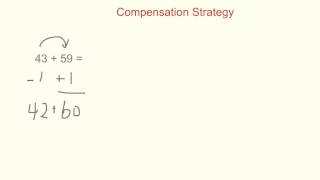
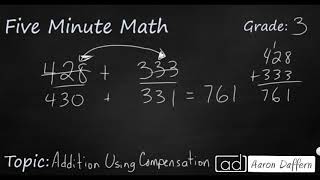
Round and adjust (adding)

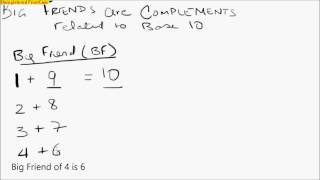
Also called Compensation for addition · Add 10 subtract 1 (adding 9) · Add 100 subtract 1 · Soroban big friend (+9 = +10 − 1)

General mental mathSingapore Math mental strategies 4 & 5Common Core (US)Japanese soroban 10-complementGerman Grundschule Hilfsaufgabe

Use it when

When one number is just under a hundred or thousand mark, like 298 or 97, and the other number can't spare the missing bit, add the round number and then take the extra back off.

How it works

298 is just 2 less than 300. Add 300 instead, then take away the extra 2.

Worked examples

BoardFastest next stepAnswer
298 + 51300 − 2 + 51= 349
Gap 2, 51 ends in 1 (less than 2), tens 9 + 5 carries. 300 + 51 = 351, 351 − 2 = 349. Check: 349 − 51 = 298.
97 + 41100 − 3 + 41= 138
Gap 3, 41 ends in 1 (less than 3), tens 9 + 4 carries. 100 + 41 = 141, 141 − 3 = 138. Check: 138 − 41 = 97.
2,997 + 4,5303,000 − 3 + 4,530= 7,527
Gap 3, 4,530 ends in 0. 3,000 + 4,530 = 7,530, minus 3 = 7,527. Check: 7,527 − 4,530 = 2,997.
49,999 + 27,35050,000 − 1 + 27,350= 77,349
Gap 1, 27,350 ends in 0. 50,000 + 27,350 = 77,350, minus 1 = 77,349. Check: 77,349 − 27,350 = 49,999.

When it doesn't fit

  • 298 + 101 There is no carry anywhere, so plain column addition is already as fast.Instead: Column addition: ones 8 + 1 = 9, tens 9 + 0 = 9, hundreds 2 + 1 = 3, giving 399
  • 96 + 41 96 is 4 below 100. A gap of 4 is too big for this rule.Instead: Column addition: ones 6 + 1 = 7, then tens 9 + 4 = 13, giving 137

The long way

Column addition, ones first: 8 + 1 = 9 ones, then 9 + 5 = 14 tens (write 4, carry 1), then 2 + 1 = 3 hundreds, giving 349.

Something off with this method? Tell us
What's wrong?

Make a ten (shift)

Also called Sakuranbo keisan / cherry calculation (さくらんぼ計算) · 加数分解 / 被加数分解 · 凑十法 (cou shi fa) · 10 만들기

Japanese grade 1 (sakuranbo keisan)Chinese grade 1 凑十法Korean grade 1 10 만들기Singapore Math number bondsCommon Core 1.OA.6 / 2.NBT

Use it when

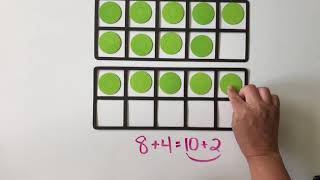
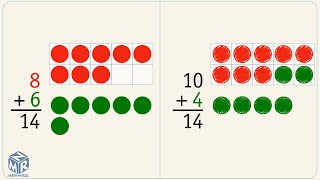
When one number is just under a ten (like 38 or 298), move a little from the other number over to it so it becomes round. The total stays the same and is easy to add.

How it works

Take a little from one number and give it to the other so one becomes a round number like 40. The total stays the same, but it is much easier to add.

Worked examples

BoardFastest next stepAnswer
47 + 3845 + 40= 85
38 has gap 2 (smaller than 47's gap 3); 7 is at least 2. 45 + 40 = 85. Check: 47 + 38 = 40 + 30 + 15 = 85.
298 + 156300 + 154= 454
298 has gap 2; 6 is at least 2. 300 + 154 = 454. Check: 454 − 156 = 298.
4.97 + 2.385 + 2.35= 7.35
4.97 is 0.03 below 5; last digit 8 is at least 3. 5 + 2.35 = 7.35. Check: 7.35 − 2.38 = 4.97.
39,998 + 27,46540,000 + 27,463= 67,463
39,998 has gap 2; 5 is at least 2. 40,000 + 27,463 = 67,463. Check: 67,463 − 27,465 = 39,998.

When it doesn't fit

  • 43 + 25 Neither number ends in 7, 8 or 9, and 3 + 5 makes no carry.Instead: Column addition: ones 3 + 5 = 8, tens 4 + 2 = 6, giving 68
  • 47 + 31 47 needs 3 to reach 50, but 31 ends in 1, so it can't give 3. There is no carry, so plain column addition is already fast.Instead: Column addition: ones 7 + 1 = 8, tens 4 + 3 = 7, giving 78

The long way

Column addition: ones 7 + 8 = 15, write 5 and carry 1, then tens 1 + 4 + 3 = 8, giving 85.

Something off with this method? Tell us
What's wrong?

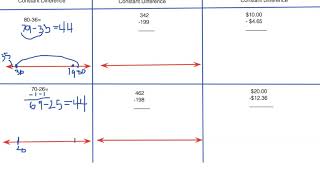
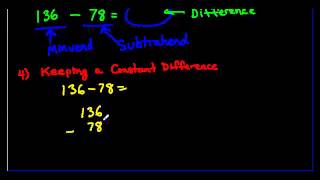
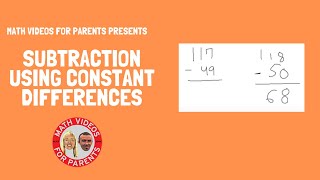
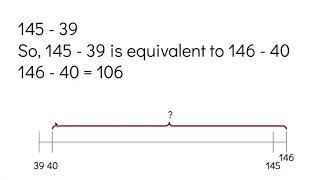
Equal addition (same difference)

Also called Constant difference · Same difference · Keep a constant difference · Shift both numbers

Common Core / Number Talks (US)Singapore MathUK National CurriculumMath is Figure-Out-Able

Use it when

When the number you take away is close to a round number, move both numbers up or down by the same amount so the take-away number becomes round. The gap between them stays the same.

How it works

Add the same amount to both numbers so the number you take away is round. The gap between them stays the same, so 83 − 38 turns into 85 − 40, which is 45.

Worked examples

BoardFastest next stepAnswer
83 − 3885 − 40= 45
38 is 2 below 40 and 83 ends in 3, so add 2 to both. 85 − 40 = 45. Check: 38 + 45 = 83.
512 − 203509 − 200= 309
203 is 3 above 200, so take 3 from both. 509 − 200 = 309. Check: 203 + 309 = 512.
4,132 − 1,9974,135 − 2,000= 2,135
1,997 is 3 below 2,000 and 4,132 ends in 2, so add 3 to both. 4,135 − 2,000 = 2,135. Check: 1,997 + 2,135 = 4,132.
62,413 − 29,99862,415 − 30,000= 32,415
29,998 is 2 below 30,000 and 62,413 ends in 3, so add 2 to both. 62,415 − 30,000 = 32,415. Check: 29,998 + 32,415 = 62,413.

When it doesn't fit

  • 89 − 38 No borrow is needed, so plain column subtraction is already fast.Instead: Column subtraction: ones 9 − 8 = 1, tens 8 − 3 = 5, giving 51
  • 402 − 157 157 is near 160, which has two nonzero digits, so shifting does not make the take-away number simple.Instead: Column subtraction: regroup 402 as 3 hundreds, 9 tens, 12 ones; ones 12 − 7 = 5 (then 9 − 5 = 4 tens, 3 − 1 = 2 hundreds), giving 245

The long way

Column subtraction with borrowing: 3 − 8 won't work, so regroup 83 as 7 tens and 13 ones. Ones 13 − 8 = 5, then tens 7 − 3 = 4, giving 45.

Something off with this method? Tell us
What's wrong?

Round and adjust (subtracting)

Also called Compensation for subtraction · Round the subtrahend and adjust · Subtract 100 add 1 · Soroban big friend subtraction (−9 = −10 + 1)

General mental mathSingapore MathCommon Core (US)Japanese sorobanGerman Grundschule Hilfsaufgabe

Use it when

When the number you take away is just under a round number, like 38 or 297, take away the round number and then give back the little bit you took too much.

How it works

Taking away 38 is almost the same as taking away 40. Take away 40, then give back the 2 extra you took.

Worked examples

BoardFastest next stepAnswer
85 − 3885 − 40 + 2= 47
38 is 2 below 40 and 85 ends in 5. 85 − 40 = 45, 45 + 2 = 47. Check: 38 + 47 = 85.
645 − 297645 − 300 + 3= 348
297 is 3 below 300 and 645 ends in 5. 645 − 300 = 345, 345 + 3 = 348. Check: 297 + 348 = 645.
6,254 − 1,9986,254 − 2,000 + 2= 4,256
1,998 is 2 below 2,000 and 6,254 ends in 4. 6,254 − 2,000 = 4,254, + 2 = 4,256. Check: 1,998 + 4,256 = 6,254.
52,365 − 29,99752,365 − 30,000 + 3= 22,368
29,997 is 3 below 30,000 and 52,365 ends in 5. 52,365 − 30,000 = 22,365, + 3 = 22,368. Check: 29,997 + 22,368 = 52,365.

When it doesn't fit

  • 599 − 497 599 ends in 9, not 4, 5 or 6, and no borrow is needed, so plain column subtraction is already fast.Instead: Column subtraction: ones 9 − 7 = 2, tens 9 − 9 = 0, hundreds 5 − 4 = 1, giving 102
  • 645 − 287 287 is near 290, which has two nonzero digits, and 13 away from 300, so it is not just under a round number.Instead: Column subtraction: regroup 645 as 6 hundreds, 3 tens, 15 ones; ones 15 − 7 = 8 (then 13 − 8 = 5 tens, 5 − 2 = 3 hundreds), giving 358

The long way

Column subtraction with borrowing: 5 − 8 won't work, so regroup 85 as 7 tens and 15 ones. Ones 15 − 8 = 7, then tens 7 − 3 = 4, giving 47.

Something off with this method? Tell us
What's wrong?

Pair to a round number

Also called Look for tens · Compatible numbers · Friendly numbers · Associative regrouping

Singapore Math number bondsCommon Core 1.OA.3 / 3.OA.5UK number bondsGeneral mental math

Use it when

In a longer adding problem, find two numbers that are both being added and make a round number like 10 or 100. Add those two first, then the rest.

How it works

Find two numbers being added that make a round number like 10 or 100. Add those two first, then add the rest.

Worked examples

BoardFastest next stepAnswer
7 + 8 + 310 + 8= 18
7 + 3 = 10 is the only round pair (7 + 8 = 15, 8 + 3 = 11). 10 + 8 = 18. Left to right: 15 + 3 = 18.
46 + 38 + 54100 + 38= 138
46 + 54 = 100 is the only round pair (84 and 92 are not). 100 + 38 = 138. Left to right: 84 + 54 = 138.
365 + 128 + 435 + 59800 + 128 + 59= 987
365 + 435 = 800 is the only round pair (493, 424, 563, 187, 494 are not). 800 + 128 + 59 = 987. Left to right: 493 + 435 = 928, + 59 = 987.
4,750 + 2,916 + 5,25010,000 + 2,916= 12,916
4,750 + 5,250 = 10,000 is the only round pair. 10,000 + 2,916 = 12,916. Left to right: 7,666 + 5,250 = 12,916.

When it doesn't fit

  • 64 + 36 + 18 The round pair is already the first two numbers, so left to right gives the same step.Instead: 100 + 18 (add the first two numbers, left to right)
  • 80 − 27 + 73 27 + 73 = 100, but 27 is being taken away. Pairing it with +73 would pull it away from its minus sign and give the wrong answer. The right answer is 126.Instead: 53 + 73 (work left to right: 80 − 27 = 53)

The long way

7 + 8 + 3 → 15 + 3 (add the first two numbers, left to right).

Something off with this method? Tell us
What's wrong?

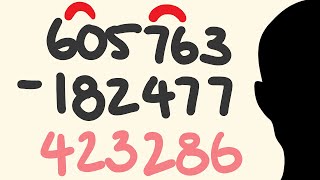
Borrow-free subtraction (all nines)

Also called All from 9 and the last from 10 · Nikhilam Navatashcaramam Dashatah · Otsuri method (おつり計算法) · 9-9-10 trick

Vedic (India) Nikhilam sutraJapan otsuri / soroban 9-complementsUK number bonds to 100Arthur Benjamin

Use it when

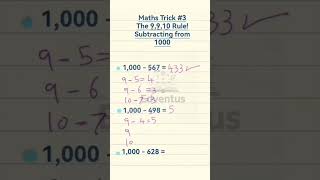
To take a number away from 100, 1000 or a round number like 500, first take 1 off the round number so it turns into nines. Then subtract with no borrowing and add the 1 back.

How it works

Take 1 away from the round number so it turns into all 9s, subtract with no borrowing at all, then add that 1 back on at the end.

Worked examples

BoardFastest next stepAnswer
100 − 4699 − 46 + 1= 54
46 is 4 from 50, so not near round. 99 − 46 = 53 (no borrowing), + 1 = 54. Check: 46 + 54 = 100.
1000 − 456999 − 456 + 1= 544
999 − 456 = 543 (9−4, 9−5, 9−6), + 1 = 544. Check: 456 + 544 = 1000.
10000 − 36549999 − 3654 + 1= 6346
9999 − 3654 = 6345, + 1 = 6346. Check: 3654 + 6346 = 10000.
90000 − 4128689999 − 41286 + 1= 48714
89999 − 41286 = 48713 (8−4, 9−1, 9−2, 9−8, 9−6), + 1 = 48714. Check: 41286 + 48714 = 90000.

When it doesn't fit

  • 1000 − 300 300 ends in 0, so there is no borrowing to avoid.Instead: 700 (10 hundreds − 3 hundreds = 7 hundreds)
  • 1003 − 387 1003 is not a number like 1000 or 500 with only zeros after the first digit, so turning it into nines does not work.Instead: Column subtraction: regroup 1003 as 9 hundreds, 9 tens, 13 ones; ones 13 − 7 = 6 (then 9 − 8 = 1 ten, 9 − 3 = 6 hundreds), giving 616

The long way

Column subtraction of 100 − 46: 0 − 6 needs a borrow, and the tens digit is 0, so borrow from the hundreds first. 100 becomes 9 tens and 10 ones; ones 10 − 6 = 4, then tens 9 − 4 = 5, giving 54.

Something off with this method? Tell us
What's wrong?

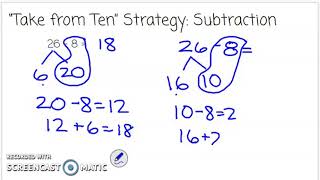
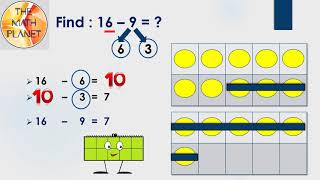
Take from ten

Also called 減加法 (genkahō) · さくらんぼ計算 (ひき算) · 破十法 (po shi fa) · 借十法

Japanese grade 1 (default method)Chinese grade 1 破十法Hong Kong P1Common Core 1.OA.6 / EngageNY

Use it when

For a teen number minus a big single digit, split the teen into 10 and its ones. Take the small number away from the 10, then add the ones back.

How it works

Split the teen number into a 10 and its ones. Take the small number away from the 10, then add the ones back.

Worked examples

BoardFastest next stepAnswer
13 − 910 − 9 + 3= 4
u = 3, d = 9, 9 − 3 = 6 (at least 3). 10 − 9 = 1, 1 + 3 = 4. Check: 9 + 4 = 13.
11 − 610 − 6 + 1= 5
u = 1, d = 6, 6 − 1 = 5. 10 − 6 = 4, 4 + 1 = 5. Check: 6 + 5 = 11.
15 − 810 − 8 + 5= 7
u = 5, d = 8, 8 − 5 = 3. 10 − 8 = 2, 2 + 5 = 7. Check: 8 + 7 = 15.
16 − 910 − 9 + 6= 7
u = 6, d = 9, 9 − 6 = 3. 10 − 9 = 1, 1 + 6 = 7. Check: 9 + 7 = 16.

When it doesn't fit

  • 17 − 5 7 is bigger than 5, so no borrow is needed.Instead: 12 (subtract the ones: 7 − 5 = 2)
  • 20 − 7 20 is not a teen number, and it already ends in 0, so there is nothing to split.Instead: 13 (regroup 20 as 1 ten and 10 ones; 10 − 7 = 3)

The long way

For 13 − 9, think addition: 9 + ? = 13, or count back 9 from 13. Either way the answer is 4.

Something off with this method? Tell us
What's wrong?

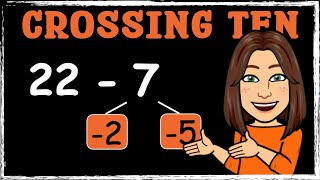
Subtract down to the ten

Also called 減減法 (genkagen-hō) · 平十法 (ping shi fa) · Use ten to subtract · Break apart ones to subtract

Japanese grade 1 (secondary method)Chinese grade 1 平十法Singapore MathCommon Core (Go Math)UK NCETM / Australia

Use it when

When taking away a single digit would cross a ten, split it so the first part takes you exactly down to the ten, then take away the rest.

How it works

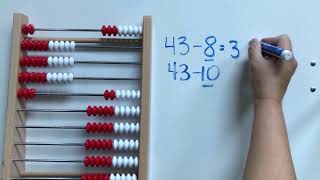
Split the number you take away so the first part brings you down to a ten, like 43 − 3 = 40. Then take away the rest: 40 − 4 = 36.

Worked examples

BoardFastest next stepAnswer
43 − 743 − 3 − 4= 36
u = 3 < 7. 43 − 3 = 40, 40 − 4 = 36. Check: 7 + 36 = 43.
82 − 582 − 2 − 3= 77
u = 2 < 5. 82 − 2 = 80, 80 − 3 = 77. Check: 5 + 77 = 82.
1,254 − 61,254 − 4 − 2= 1,248
u = 4 < 6. 1,254 − 4 = 1,250, − 2 = 1,248. Check: 6 + 1,248 = 1,254.
63,573 − 763,573 − 3 − 4= 63,566
u = 3 < 7. 63,573 − 3 = 63,570, − 4 = 63,566. Check: 7 + 63,566 = 63,573.

When it doesn't fit

  • 48 − 5 8 is bigger than 5, so you don't cross a ten.Instead: 43 (subtract the ones: 8 − 5 = 3)
  • 40 − 7 40 already ends in 0, so there is no first part to take down to the ten.Instead: 33 (regroup 40 as 3 tens and 10 ones; 10 − 7 = 3)

The long way

Column subtraction: regroup 43 as 3 tens and 13 ones; ones 13 − 7 = 6, giving 36.

Something off with this method? Tell us
What's wrong?

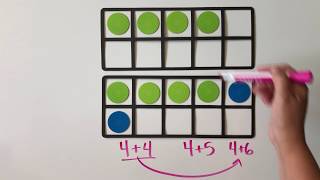
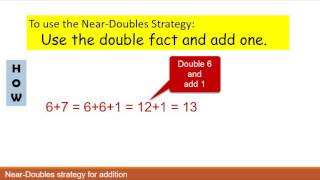
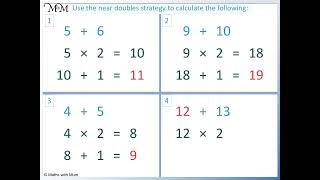
Near doubles

Also called Doubles plus one · Doubles minus one · Verdopplungsaufgaben · Use doubles

Common Core 1.OA.6Singapore MathUK/Australia Year 1-2German Grundschule

Use it when

When two numbers are almost the same, turn the bigger one into the smaller one plus a little bit. Add the double you know, then add the little bit.

How it works

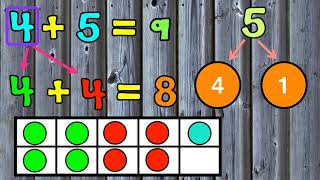
When two numbers are almost the same, turn the bigger one into the smaller one plus a little bit. Add the double you already know, then add the little bit.

Worked examples

BoardFastest next stepAnswer
6 + 76 + 6 + 1= 13
Differ by 1, both 5 to 7. 6 + 6 = 12, + 1 = 13. Check: 13 − 7 = 6.
35 + 3735 + 35 + 2= 72
Differ by 2, smaller ends in 5. 35 + 35 = 70, + 2 = 72. Check: 30 + 30 + 5 + 7 = 72.
75 + 7675 + 75 + 1= 151
Differ by 1, smaller ends in 5. 75 + 75 = 150, + 1 = 151. Check: 151 − 76 = 75.
125 + 127125 + 125 + 2= 252
Differ by 2, smaller ends in 5. 125 + 125 = 250, + 2 = 252. Check: 252 − 127 = 125.

When it doesn't fit

  • 33 + 34 33 does not end in 5, so 33 + 33 is not an easy double, and there is no carry to save.Instead: Column addition: ones 3 + 4 = 7, tens 3 + 3 = 6, giving 67
  • 4 + 5 The two make less than 11, so it is a fact you just know.Instead: 9 (recall the fact)

The long way

6 + 7 → 13 (recall the fact, or count on 6 from 7: 8, 9, 10, 11, 12, 13).

Something off with this method? Tell us
What's wrong?

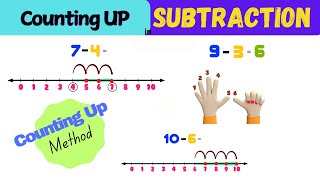
Count up to subtract

Also called Adding up · Think addition · Shopkeeper's method · Making change

Common Core (US)Singapore MathUK National CurriculumGerman Grundschule ErgänzenDutch aanvullen

Use it when

When the two numbers sit close together on either side of a round number, count up from the smaller number to the round number, then on to the bigger one.

How it works

When the two numbers sit on either side of a round number, count up to the round number and then on to the top number. 396 to 400 is 4, 400 to 403 is 3, so the answer is 7.

Worked examples

BoardFastest next stepAnswer
81 − 77(80 − 77) + 1= 4
80 lies between; gaps 1 and 3. 3 + 1 = 4. Check: 77 + 4 = 81.
403 − 396(400 − 396) + 3= 7
400 lies between; gaps 3 and 4. 4 + 3 = 7. Check: 396 + 7 = 403.
1003 − 996(1000 − 996) + 3= 7
1000 lies between; gaps 3 and 4. 4 + 3 = 7. Check: 996 + 7 = 1003.
30004 − 29996(30000 − 29996) + 4= 8
30000 lies between; gaps 4 and 4. 4 + 4 = 8. Check: 29996 + 8 = 30004.

When it doesn't fit

  • 400 − 396 400 is already the round number, so there is nothing to split. Counting up is already one step.Instead: 4 (count up from 396 to 400)
  • 403 − 128 The numbers are far apart, so no round number sits within 9 of both.Instead: Column subtraction: regroup 403 as 3 hundreds, 9 tens, 13 ones; ones 13 − 8 = 5 (then 9 − 2 = 7 tens, 3 − 1 = 2 hundreds), giving 275

The long way

Column subtraction with borrowing: 1 − 7 won't work, so regroup 81 as 7 tens and 11 ones. Ones 11 − 7 = 4, tens 7 − 7 = 0, giving 4.

Something off with this method? Tell us
What's wrong?

Jump strategy (take away the tens first)

Also called Add the tens first · Rijgen · Schrittweise rechnen · Count up by place value

Australia/UK jump strategyDutch rijgenGerman schrittweise am RechenstrichSingapore 'add the tens'Common Core open number line

Use it when

Keep the first number whole. Take away the tens of the second number in one jump, then take away the leftover ones.

How it works

Keep the first number whole. Take away the tens of the second number in one jump, then take away the leftover ones.

Worked examples

BoardFastest next stepAnswer
83 − 2563 − 5= 58
25 ends in 5; 3 < 5 so a borrow is needed. 83 − 20 = 63, 63 − 5 = 58. Check: 25 + 58 = 83.
735 − 46695 − 6= 689
46 ends in 6; 5 < 6. 735 − 40 = 695, 695 − 6 = 689. Check: 46 + 689 = 735.
92 − 3662 − 6= 56
36 ends in 6; 2 < 6. 92 − 30 = 62, 62 − 6 = 56. Check: 36 + 56 = 92.
451 − 65391 − 5= 386
65 ends in 5; 1 < 5. 451 − 60 = 391, 391 − 5 = 386. Check: 65 + 386 = 451.

When it doesn't fit

  • 86 − 25 6 is bigger than 5, so no borrow is needed and column subtraction is already fast.Instead: Column subtraction: ones 6 − 5 = 1, tens 8 − 2 = 6, giving 61
  • 235 − 146 146 has 3 digits, which is outside this rule.Instead: Column subtraction: regroup 235 as 1 hundred, 12 tens, 15 ones; ones 15 − 6 = 9 (then 12 − 4 = 8 tens, 1 − 1 = 0 hundreds), giving 89

The long way

Column subtraction with borrowing: 3 − 5 won't work, so regroup 83 as 7 tens and 13 ones. Ones 13 − 5 = 8, then tens 7 − 2 = 5, giving 58.

Something off with this method? Tell us
What's wrong?

Partial sums (split both by place value)

Also called Split strategy · Partitioning · Expanded addition · Left-to-right addition

Common Core 2.NBT.7 / Everyday MathematicsUK partitioningAustralia split strategyArthur Benjamin

Use it when

Add the tens together and the ones together (and the hundreds together), then put the answers together.

How it works

Add the tens together and the ones together, then put the two answers together.

Worked examples

BoardFastest next stepAnswer
26 + 3550 + 11= 61
Ones 6 + 5 carry, neither ends in 7 to 9, 9 apart. 20 + 30 = 50, 6 + 5 = 11, 50 + 11 = 61. Check: 61 − 35 = 26.
56 + 66110 + 12= 122
Ones 6 + 6 carry, 10 apart. 50 + 60 = 110, 6 + 6 = 12, total 122. Check: 122 − 66 = 56.
345 + 286500 + 120 + 11= 631
Ones 5 + 6 carry. 300 + 200 = 500, 40 + 80 = 120, 5 + 6 = 11, total 631. Check: 631 − 286 = 345.
756 + 4651100 + 110 + 11= 1221
Ones 6 + 5 carry. 700 + 400 = 1100, 50 + 60 = 110, 6 + 5 = 11, total 1221. Check: 1221 − 465 = 756.

When it doesn't fit

  • 56 + 40 40 ends in 0, so the ones add to less than 10 and there is no carry.Instead: 96 (add the tens: 50 + 40 = 90, keep the 6)
  • 54 + 34 4 + 4 = 8 makes no carry, so column addition is already one step per column.Instead: Column addition: ones 4 + 4 = 8, tens 5 + 3 = 8, giving 88

The long way

Column addition: ones 6 + 5 = 11, write 1 and carry 1, then tens 1 + 2 + 3 = 6, giving 61.

Something off with this method? Tell us
What's wrong?

Merge double signs

Also called Keep-change-change · Add the opposite · Two negatives make a positive · Changing double signs

Common Core 7.NS.1UK directed numbers

Use it when

When two signs sit side by side, turn them into one sign. Two that match make a plus, two that are different make a minus.

How it works

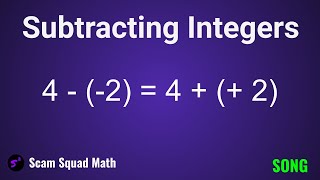
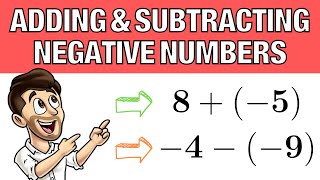
When two signs sit side by side, turn them into one sign. Two that match make a plus and two that are different make a minus, so 9 − (−4) is just 9 + 4.

Worked examples

BoardFastest next stepAnswer
9 − (−4)9 + 4= 13
Minus and minus match, so +. 9 + 4 = 13. Check: 13 − 9 = 4, and taking away −4 is adding 4.
47 − (+18)47 − 18= 29
Minus and plus differ, so −. 47 − 18 = 29. Check: 18 + 29 = 47.
356 + (−729)356 − 729= −373
Plus and minus differ, so −. 729 − 356 = 373, and the answer is negative: −373. Check: −373 + 729 = 356.
48,205 − (−31,768)48,205 + 31,768= 79,973
Minus and minus match, so +. 48,205 + 31,768 = 79,973. Check: 79,973 − 31,768 = 48,205.

When it doesn't fit

  • −6 + 2 The minus is a leading sign with no operator in front of it, so there are not two signs to merge.Instead: −4 (combine −6 and 2)
  • 15 − (8 − 3) The minus is in front of a bracket with two numbers in it, not a single signed number.Instead: 15 − 5 (work out the brackets first)

The long way

Add the opposite (keep, change, change): keep 9, change subtract to add, change −4 to +4, giving 9 + (+4), then 13.

Something off with this method? Tell us
What's wrong?

Group the take-aways

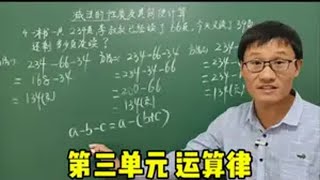
Also called Subtract a sum at once · Property of subtraction: a − b − c = a − (b + c) · 减法的性质 / 连减的性质 · 連減兩數

General mental mathChinese PEP Grade 4 (人教版四年级下册 运算律: 减法的性质 / 连减的性质)Taiwan elementary 簡便運算 (連減兩數)

Use it when

When two numbers are both being taken away and they add up to a round number, add them together first and take them away in one go.

How it works

When two numbers are both being taken away and they add up to a round number, add them together first and take them away in one go.

Worked examples

BoardFastest next stepAnswer
486 − 37 − 63486 − 100= 386
37 + 63 = 100 (both 2-digit, multiple of 100); 486 − 37 needs a borrow. 486 − 100 = 386. Left to right: 449 − 63 = 386.
75 − 8 − 1275 − 20= 55
8 + 12 = 20 (larger is a teen, multiple of 10); 75 − 8 needs a borrow. 75 − 20 = 55. Left to right: 67 − 12 = 55.
9.6 − 1.3 − 2.79.6 − 4= 5.6
1.3 + 2.7 = 4 (a whole number); 9.6 − 1.3 = 8.3 is not whole. 9.6 − 4 = 5.6. Left to right: 8.3 − 2.7 = 5.6.
823 − 145 − 255 + 60823 − 400 + 60= 483
145 + 255 = 400; the added terms 823 + 60 = 883 are not round; 823 − 145 needs a borrow. 823 − 400 = 423, + 60 = 483. Left to right: 678 − 255 = 423, + 60 = 483.

When it doesn't fit

  • 486 − 37 + 63 Only 37 is taken away; 63 is added. Pairing them would pull 37 away from its minus sign and give 386 instead of the right answer 512.Instead: 449 + 63 (work left to right)
  • 250 − 50 − 150 50 + 150 = 200, but 250 − 50 already lands on 200 with no borrowing, so grouping saves nothing. The answer is 50.Instead: 200 − 150 (work left to right)

The long way

486 − 37 − 63 → 449 − 63 (subtract from left to right).

Something off with this method? Tell us
What's wrong?

Multiply & Divide

Turn hard products into easy ones: halve, double, round, and split. 23 methods

×5 is half of ×10

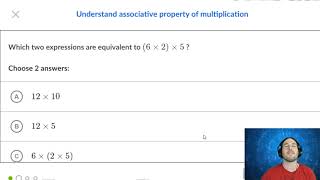
Also called Multiply by 5 trick · Halve and add a zero · Trachtenberg ×5 (half the neighbor) · Split a factor to make ten (5 × 2 × 9)

General mental mathTrachtenberg systemCommon Core / UK times-table strategyKhan Academy associative property

Use it when

Times 5 is half of times 10. If the number is even, halve it and times by 10; if it is odd, times by 10 and then halve.

How it works

Times 5 is half of times 10. Cut the number in half and add a zero, or add the zero first and then cut it in half.

Worked examples

BoardFastest next stepAnswer
68 × 534 × 10= 340
68 × 5 = 340 and 34 × 10 = 340, same value.
5 × 3737 × 10 ÷ 2= 185
5 × 37 = 185 and 37 × 10 ÷ 2 = 185, same value.
98 × 549 × 10= 490
98 × 5 = 490 and 49 × 10 = 490, same value.
4,973 × 54,973 × 10 ÷ 2= 24,865
4,973 × 5 = 24,865 and 4,973 × 10 ÷ 2 = 24,865, same value.

When it doesn't fit

  • 5 × 17 × 2 Three factors, and 5 × 2 makes 10, so Friendly pair first goes first.Instead: 10 × 17 (Friendly pair first: combine 5 × 2 = 10)
  • 5 × 12 12 is in the times tables, so just recall it.Instead: 60 (recall the times-table fact)

The long way

Column multiplication: 5 × 8 ones = 40, write 0 and carry 4, then 5 × 6 tens = 30, plus 4 is 34, so 68 × 5 = 340.

Something off with this method? Tell us
What's wrong?

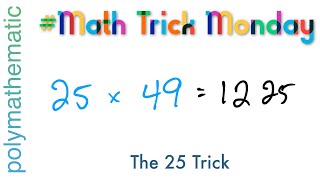
×25 trick

Also called 25 is a quarter of 100 · ×100 ÷ 4 · Quarters method

General mental mathMath Trick MondayVedic-branded collections

Use it when

Four 25s make 100. If the other number splits into fours, take a quarter of it and times by 100.

How it works

Four 25s make 100. 48 is 12 fours, so 48 × 25 is 12 hundreds, which is 1200.

Worked examples

BoardFastest next stepAnswer
48 × 2512 × 100= 1,200
48 × 25 = 1,200 and 12 × 100 = 1,200, same value.
25 × 12431 × 100= 3,100
25 × 124 = 3,100 and 31 × 100 = 3,100, same value.
12 × 253 × 100= 300
12 × 25 = 300 and 3 × 100 = 300, same value.
25 × 5213 × 100= 1,300
25 × 52 = 1,300 and 13 × 100 = 1,300, same value.

When it doesn't fit

  • 34 × 25 34 is not a multiple of 4, so a quarter of it is not a whole number.Instead: 30 × 25 + 4 × 25 (textbook: split 34 by place value)
  • 4 × 7 × 25 Three factors with 4 and 25 already there, so Friendly pair first just pairs them.Instead: 7 × 100 (Friendly pair first: combine 4 × 25)

The long way

Split by place value and multiply each part: 48 × 25 → 40 × 25 + 8 × 25 = 1000 + 200 = 1200.

Something off with this method? Tell us
What's wrong?

×50 is half of ×100

Also called Multiply by 50 trick

General mental mathTMSCA/UIL Number Sense

Use it when

Times 50 is half of times 100. Halve the even number and times by 100.

How it works

Times 50 is half of times 100. Cut the other number in half and add two zeros.

Worked examples

BoardFastest next stepAnswer
36 × 5018 × 100= 1,800
36 × 50 = 1,800 and 18 × 100 = 1,800, same value.
248 × 50124 × 100= 12,400
248 × 50 = 12,400 and 124 × 100 = 12,400, same value.
50 × 4824 × 100= 2,400
50 × 48 = 2,400 and 24 × 100 = 2,400, same value.
50 × 4,6822,341 × 100= 234,100
50 × 4,682 = 234,100 and 2,341 × 100 = 234,100, same value.

When it doesn't fit

  • 37 × 50 37 is odd, so half of it is not whole.Instead: 37 × 5 × 10 (Multiply by a multiple of 10 (pull out the zeros): split 50 → 5 × 10)
  • 50 × 7 7 is a single digit, so pulling out the zero is just as quick.Instead: 5 × 10 × 7 (Multiply by a multiple of 10 (pull out the zeros))

The long way

Column multiplication: 36 × 0 = 0 in the ones place, then 36 × 5 = 180 in the tens place, giving 1800.

Something off with this method? Tell us
What's wrong?

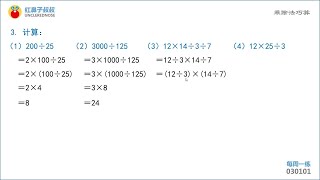
×125 trick

Also called ×1000 ÷ 8 · Eighth and ×1000

General mental mathIndian exam-prep shortcuts

Use it when

Eight 125s make 1000. If the other number splits into eights, take an eighth of it and times by 1000.

How it works

Eight 125s make 1000. 16 is two eights, so 16 × 125 is 2 thousands, which is 2000.

Worked examples

BoardFastest next stepAnswer
16 × 1252 × 1000= 2,000
16 × 125 = 2,000 and 2 × 1000 = 2,000, same value.
125 × 486 × 1000= 6,000
125 × 48 = 6,000 and 6 × 1000 = 6,000, same value.
136 × 12517 × 1000= 17,000
136 × 125 = 17,000 and 17 × 1000 = 17,000, same value.
80 × 12510 × 1000= 10,000
80 × 125 = 10,000 and 10 × 1000 = 10,000, same value.

When it doesn't fit

  • 36 × 125 36 is not a multiple of 8.Instead: 30 × 125 + 6 × 125 (textbook: split 36 by place value)
  • 8 × 125 8 × 125 is already the 1000 fact.Instead: 1000 (recall the fact)

The long way

Split by place value and multiply each part: 64 × 125 → 60 × 125 + 4 × 125 = 7500 + 500 = 8000.

Something off with this method? Tell us
What's wrong?

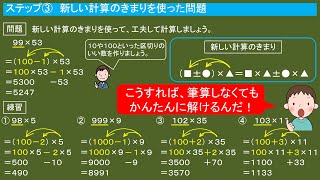
Near-round multiplier

Also called Compensation for multiplication · Round a factor and adjust · ×9 = ×10 − ×1 · ×99 = ×100 − ×1

General mental mathCommon Core / Number TalksVedic (India)Trachtenberg systemArthur Benjamin

Use it when

If one number is just 1 or 2 away from a round number like 20, 100 or 1000, use the round number and fix up the little bit.

How it works

99 is just 1 less than 100. Do 100 × 7 = 700, then take away one 7 to get 693.

Worked examples

BoardFastest next stepAnswer
99 × 7(100 − 1) × 7= 693
99 × 7 = 693 and (100 − 1) × 7 = 693, same value.
102 × 34(100 + 2) × 34= 3,468
102 × 34 = 3,468 and (100 + 2) × 34 = 3,468, same value.
198 × 35(200 − 2) × 35= 6,930
198 × 35 = 6,930 and (200 − 2) × 35 = 6,930, same value.
999 × 456(1000 − 1) × 456= 455,544
999 × 456 = 455,544 and (1000 − 1) × 456 = 455,544, same value.

When it doesn't fit

  • 49 × 51 Both sit 1 away from 50 on opposite sides, so difference of squares is faster.Instead: 50² − 1² (Difference of squares)
  • 97 × 98 Both are just under 100, so near-base multiplication is faster.Instead: 95 × 100 + 3 × 2 (Near-base multiplication (both near 100))

The long way

Column multiplication: 7 × 9 ones = 63, write 3 carry 6; 7 × 9 tens = 63, plus 6 is 69, so 99 × 7 = 693. As one move: 99 × 7 → 90 × 7 + 9 × 7.

Something off with this method? Tell us
What's wrong?

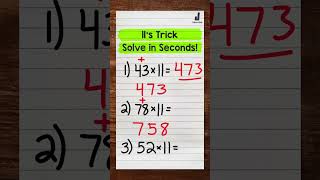
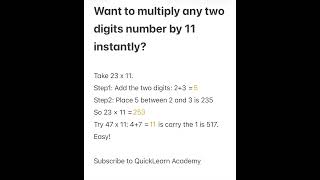
×11 is ×10 plus one more

Also called Multiply by 11 trick · Add neighbouring digits · Trachtenberg ×11 · Split and add

General mental mathVedic (India)Trachtenberg systemMath with Mr. J

Use it when

Times 11 is times 10 plus one more of the number.

How it works

Times 11 is times 10 plus one more. 11 × 34 is 340 + 34 = 374.

Worked examples

BoardFastest next stepAnswer
11 × 34(10 + 1) × 34= 374
11 × 34 = 374 and (10 + 1) × 34 = 374, same value.
64 × 1164 × (10 + 1)= 704
64 × 11 = 704 and 64 × (10 + 1) = 704, same value.
11 × 15(10 + 1) × 15= 165
11 × 15 = 165 and (10 + 1) × 15 = 165, same value.
11 × 789(10 + 1) × 789= 8,679
11 × 789 = 8,679 and (10 + 1) × 789 = 8,679, same value.

When it doesn't fit

  • 11 × 19 Same tens digit and 1 + 9 = 10, so same-tens wins.Instead: 1 × 2 × 100 + 1 × 9 (Same tens, ones make 10)
  • 11 × 99 99 is 1 away from 100, so near-round wins.Instead: 11 × (100 − 1) (Near-round multiplier)

The long way

Column multiplication: 34 × 1 = 34 on the first row, 34 × 10 = 340 on the next row, then 34 + 340 = 374.

Something off with this method? Tell us
What's wrong?

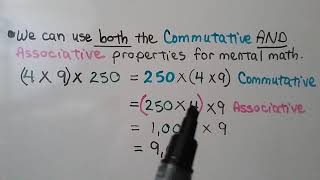
Friendly pair first

Also called Compatible factors · Associative property of multiplication · 結合のきまり · 計算の工夫

Japanese grade 4 計算のきまりCommon Core 3.OA.5Khan AcademyGeneral mental math

Use it when

In a times chain, find the two numbers that make 10, 100 or 1000 and multiply them first.

How it works

Look for two numbers that make 10, 100 or 1000 and multiply those first. Then the rest is easy.

Worked examples

BoardFastest next stepAnswer
25 × 7 × 4100 × 7= 700
25 × 7 × 4 = 700 and 100 × 7 = 700, same value.
5 × 13 × 210 × 13= 130
5 × 13 × 2 = 130 and 10 × 13 = 130, same value.
125 × 37 × 81000 × 37= 37,000
125 × 37 × 8 = 37,000 and 1000 × 37 = 37,000, same value.
25 × 98 × 4100 × 98= 9,800
25 × 98 × 4 = 9,800 and 100 × 98 = 9,800, same value.

When it doesn't fit

  • 25 × 4 × 7 The friendly pair is already first, so the normal left-to-right step does it.Instead: 100 × 7 (textbook: left to right)
  • 125 × 9 ÷ 8 The chain has a ÷, so you cannot regroup across it.Instead: 1125 ÷ 8 (textbook: left to right)

The long way

Multiply left to right: 25 × 7 × 4 → 175 × 4.

Something off with this method? Tell us
What's wrong?

Halve and double

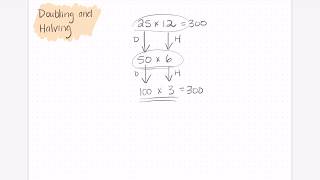
Also called Doubling and halving · Double and halve · Verdoppeln und Halbieren · Gegensinniges Verändern (multiplication)

Common Core Number TalksUK mental methodsOntario mathGerman GrundschuleRussian peasant / Egyptian multiplication

Use it when

If one number is a small even number (4 to 18) and the other is 15, 25, 35 or 45, halve the even one and double the other. You get an easy times-table fact with a zero.

How it works

Cut the even number in half and double the number ending in 5 so it ends in 0. The answer stays the same and the new problem is easy.

Worked examples

BoardFastest next stepAnswer
14 × 157 × 30= 210
14 × 15 = 210 and 7 × 30 = 210, same value.
18 × 459 × 90= 810
18 × 45 = 810 and 9 × 90 = 810, same value.
6 × 353 × 70= 210
6 × 35 = 210 and 3 × 70 = 210, same value.
12 × 456 × 90= 540
12 × 45 = 540 and 6 × 90 = 540, same value.

When it doesn't fit

  • 24 × 25 24 is a multiple of 4, so jump straight to hundreds with ×25 trick.Instead: 6 × 100 (×25 trick)
  • 46 × 35 Half of 46 is 23, so the new problem is not an easy fact.Instead: 40 × 35 + 6 × 35 (textbook: split 46 by place value)

The long way

Split by place value and multiply each part: 14 × 15 → 14 × 10 + 14 × 5 = 140 + 70 = 210.

Something off with this method? Tell us
What's wrong?

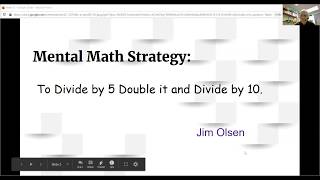
÷5 is double then ÷10

Also called Divide by 5 trick · ÷50 = ×2 ÷100

General mental mathGRE/SAT prep (Magoosh)tecmath

Use it when

Dividing by 5 is hard but dividing by 10 is easy, so double both numbers first. Do the same for ÷50 to get ÷100.

How it works

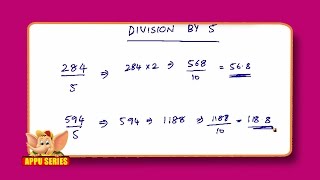
Dividing by 5 is hard but dividing by 10 is easy. Double both numbers first: 37 ÷ 5 turns into 74 ÷ 10, which is 7.4.

Worked examples

BoardFastest next stepAnswer
37 ÷ 574 ÷ 10= 7.4
37 ÷ 5 = 7.4 and 74 ÷ 10 = 7.4, same value.
437 ÷ 50874 ÷ 100= 8.74
437 ÷ 50 = 8.74 and 874 ÷ 100 = 8.74, same value.
1,284 ÷ 52,568 ÷ 10= 256.8
1,284 ÷ 5 = 256.8 and 2,568 ÷ 10 = 256.8, same value.
85 ÷ 5170 ÷ 10= 17
85 ÷ 5 = 17 and 170 ÷ 10 = 17, same value.

When it doesn't fit

  • 45 ÷ 5 The answer is a times-table fact.Instead: 9 (recall 5 × 9 = 45)
  • 300 ÷ 50 The answer is a times-table fact.Instead: 6 (recall 50 × 6 = 300)

The long way

Long division: 5 goes into 37 seven times (35) with 2 left over, then 20 tenths ÷ 5 = 4 tenths, so 7.4.

Something off with this method? Tell us
What's wrong?

Halve both first

Also called Halve then halve again · Divide by 4 or 8 by halving

UK/US/Australian primary mental strategies

Use it when

When you divide by an even number like 4, 6, 8, 14 or 18 and it goes in exactly, halve both numbers first. The answer stays the same and the divisor gets small.

How it works

When both numbers are even, cut them both in half first. The answer stays the same, and dividing by a small number is easier.

Worked examples

BoardFastest next stepAnswer
84 ÷ 442 ÷ 2= 21
84 ÷ 4 = 21 and 42 ÷ 2 = 21, same value.
486 ÷ 18243 ÷ 9= 27
486 ÷ 18 = 27 and 243 ÷ 9 = 27, same value.
728 ÷ 14364 ÷ 7= 52
728 ÷ 14 = 52 and 364 ÷ 7 = 52, same value.
84 ÷ 642 ÷ 3= 14
84 ÷ 6 = 14 and 42 ÷ 3 = 14, same value.

When it doesn't fit

  • 56 ÷ 8 The answer is a times-table fact.Instead: 7 (recall 7 × 8 = 56)
  • 42 ÷ 14 The answer is only 3, so trying a small multiple is just as fast.Instead: 3 (try 14 × 3 = 42)

The long way

Long division: 4 goes into 8 tens 2 times, write 2; then 4 goes into 4 ones 1 time, so 84 ÷ 4 = 21.

Something off with this method? Tell us
What's wrong?

Double-double (×4, ×8)

Also called Double double · Double double double (×8) · Doubling strategy

Common Core 3.OA fact strategiesSingapore MathORIGO / UK times-table strategies

Use it when

Times 4 is double twice, and times 8 is double three times. Double the big number and halve the 4 or 8.

How it works

Times 4 is the same as doubling twice. Double the big number and halve the 4 until it is gone: 17 × 4 becomes 34 × 2, which is 68.

Worked examples

BoardFastest next stepAnswer
13 × 426 × 2= 52
13 × 4 = 52 and 26 × 2 = 52, same value.
36 × 472 × 2= 144
36 × 4 = 144 and 72 × 2 = 144, same value.
23 × 846 × 4= 184
23 × 8 = 184 and 46 × 4 = 184, same value.
8 × 374 × 74= 296
8 × 37 = 296 and 4 × 74 = 296, same value.

When it doesn't fit

  • 4 × 99 99 is 1 away from 100, so near-round wins.Instead: 4 × (100 − 1) (Near-round multiplier)
  • 7 × 8 Both numbers are in the times tables.Instead: 56 (recall the fact)

The long way

Split by place value and multiply each part: 17 × 4 → 10 × 4 + 7 × 4 = 40 + 28 = 68.

Something off with this method? Tell us
What's wrong?

÷25 or ÷125: scale to 100 or 1000

Also called ÷25 = ×4 ÷100 · ÷125 = ×8 ÷1000

General mental mathtecmathVedic-branded exam videos

Use it when

Four 25s make 100 and eight 125s make 1000. Times both numbers by 4 (or 8) and you just divide by 100 (or 1000).

How it works

Four 25s make 100 and eight 125s make 1000. Times both numbers by 4 (or 8), and the division becomes just moving the decimal point.

Worked examples

BoardFastest next stepAnswer
37 ÷ 25148 ÷ 100= 1.48
37 ÷ 25 = 1.48 and 148 ÷ 100 = 1.48, same value.
875 ÷ 253,500 ÷ 100= 35
875 ÷ 25 = 35 and 3,500 ÷ 100 = 35, same value.
2,340 ÷ 12518,720 ÷ 1000= 18.72
2,340 ÷ 125 = 18.72 and 18,720 ÷ 1000 = 18.72, same value.
46,875 ÷ 125375,000 ÷ 1000= 375
46,875 ÷ 125 = 375 and 375,000 ÷ 1000 = 375, same value.

When it doesn't fit

  • 175 ÷ 25 The answer is a times-table fact.Instead: 7 (recall 25 × 7 = 175)
  • 500 ÷ 125 The answer is a small known fact.Instead: 4 (recall 125 × 4 = 500)

The long way

Long division: 25 goes into 37 once with 12 left, then 120 ÷ 25 = 4 with 20 left, then 200 ÷ 25 = 8, so 1.48.

Something off with this method? Tell us
What's wrong?

Near-base multiplication (both near 100)

Also called Nikhilam base method · Cross-subtraction · Close-together method (Benjamin) · Base 100 multiplication

Vedic (India) Nikhilam sutraArthur Benjamin

Use it when

When both numbers are a little under (or over) 100, take one number minus (or plus) the other one's gap for the front, then multiply the two gaps for the end.

How it works

When both numbers are just under 100, take one number minus the other one's gap for the front, then multiply the two gaps for the last two digits: 97 × 96 gives 93 and 3 × 4 = 12, so 9312.

Worked examples

BoardFastest next stepAnswer
97 × 9693 × 100 + 3 × 4= 9,312
97 × 96 = 9,312 and 93 × 100 + 3 × 4 = 9,312, same value.
92 × 9486 × 100 + 8 × 6= 8,648
92 × 94 = 8,648 and 86 × 100 + 8 × 6 = 8,648, same value.
107 × 104111 × 100 + 7 × 4= 11,128
107 × 104 = 11,128 and 111 × 100 + 7 × 4 = 11,128, same value.
994 × 997991 × 1000 + 6 × 3= 991,018
994 × 997 = 991,018 and 991 × 1000 + 6 × 3 = 991,018, same value.

When it doesn't fit

  • 98 × 99 99 is just 1 under 100, so near-round is as quick and more standard.Instead: 98 × (100 − 1) (Near-round multiplier)
  • 97 × 104 The numbers are on opposite sides of 100.Instead: 97 × 100 + 97 × 4 (textbook: split 104 by place value)

The long way

Split by place value and multiply each part: 97 × 96 → 97 × 90 + 97 × 6 = 8730 + 582 = 9312.

Something off with this method? Tell us
What's wrong?

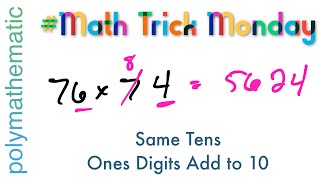
Same tens, ones make 10

Also called Antyayordashake'pi · Last digits add to ten

Vedic (India)General mental math

Use it when

When two numbers have the same tens digit and their ones digits add to 10, multiply the tens digit by the next number up, then put the two ones digits multiplied on the end.

How it works

Same tens digit and ones that add to 10: multiply the tens digit by the next number up, then put the ones multiplied on the end. 23 × 27 is 2 × 3 = 6, then 3 × 7 = 21, so 621.

Worked examples

BoardFastest next stepAnswer
23 × 272 × 3 × 100 + 3 × 7= 621
23 × 27 = 621 and 2 × 3 × 100 + 3 × 7 = 621, same value.
49 × 414 × 5 × 100 + 9 × 1= 2,009
49 × 41 = 2,009 and 4 × 5 × 100 + 9 × 1 = 2,009, same value.
92 × 989 × 10 × 100 + 2 × 8= 9,016
92 × 98 = 9,016 and 9 × 10 × 100 + 2 × 8 = 9,016, same value.
12 × 181 × 2 × 100 + 2 × 8= 216
12 × 18 = 216 and 1 × 2 × 100 + 2 × 8 = 216, same value.

When it doesn't fit

  • 43 × 46 3 + 6 is not 10.Instead: 43 × 40 + 43 × 6 (textbook: split 46 by place value)
  • 37 × 77 The tens digits are different.Instead: 37 × 70 + 37 × 7 (textbook: split 77 by place value)

The long way

Split by place value and multiply each part: 23 × 27 → 23 × 20 + 23 × 7 = 460 + 161 = 621.

Something off with this method? Tell us
What's wrong?

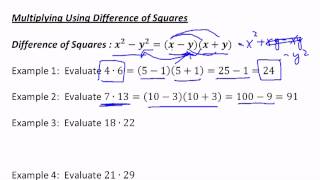
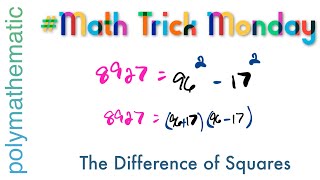
Difference of squares

Also called (m − d)(m + d) = m² − d² · Binomische Formel (Kopfrechnen) · Midpoint squared minus distance squared

General mental math / algebra identityArthur BenjaminGerman KopfrechnenMATHCOUNTS

Use it when

When two numbers sit the same small distance either side of a round number, square the round number and take away the distance squared.

How it works

When two numbers sit the same distance from a round number, square the round number and take away the square of the distance. 47 × 53 is 50 × 50 minus 3 × 3.

Worked examples

BoardFastest next stepAnswer
19 × 2120² − 1²= 399
19 × 21 = 399 and 400 − 1 = 399, same value.
47 × 5350² − 3²= 2,491
47 × 53 = 2,491 and 2500 − 9 = 2,491, same value.
98 × 102100² − 2²= 9,996
98 × 102 = 9,996 and 10000 − 4 = 9,996, same value.
4,996 × 5,0045000² − 4²= 24,999,984
4,996 × 5,004 = 24,999,984 and 25,000,000 − 16 = 24,999,984, same value.

When it doesn't fit

  • 49 × 52 49 + 52 is odd, so there is no whole-number middle.Instead: (50 − 1) × 52 (Near-round multiplier)
  • 23 × 27 The middle is 25, not a multiple of 10, and same-tens owns this one.Instead: 2 × 3 × 100 + 3 × 7 (Same tens, ones make 10)

The long way

Split by place value and multiply each part: 47 × 53 → 47 × 50 + 47 × 3 = 2350 + 141 = 2491.

Something off with this method? Tell us
What's wrong?

Break apart a factor (partial products)

Also called Partial products · Distributive property strategy · Left-to-right multiplication · Grid method

Common Core 3.OA.5 / 4.NBT.5UK grid methodArthur BenjaminVedic (India)

Use it when

Split the bigger number into hundreds, tens and ones, so you can times each easy piece by the small number and add them up.

How it works

Split the big number into its hundreds, tens and ones, like 53 = 50 + 3. Times each easy piece and add them up.

Worked examples

BoardFastest next stepAnswer
6 × 536 × (50 + 3)= 318
6 × 53 = 318 and 6 × (50 + 3) = 318, same value.
7 × 157 × (10 + 5)= 105
7 × 15 = 105 and 7 × (10 + 5) = 105, same value.
8 × 7348 × (700 + 30 + 4)= 5,872
8 × 734 = 5,872 and 8 × (700 + 30 + 4) = 5,872, same value.
300 × 476300 × (400 + 70 + 6)= 142,800
300 × 476 = 142,800 and 300 × (400 + 70 + 6) = 142,800, same value.

When it doesn't fit

  • 6 × 98 98 is 2 away from 100, so near-round wins.Instead: 6 × (100 − 2) (Near-round multiplier)
  • 23 × 47 Both numbers are 2-digit, so this is plain long multiplication.Instead: 23 × 40 + 23 × 7 (textbook)

The long way

Column multiplication: 6 × 3 = 18, write 8 carry 1; 6 × 5 tens = 30 tens, plus 1 is 31, so 6 × 53 = 318.

Something off with this method? Tell us
What's wrong?

×12 is ×10 plus double

Also called Multiply by 12 trick · Trachtenberg ×12

General mental mathTrachtenberg system

Use it when

Times 12 is times 10 plus times 2. Do ten of the number, then add double the number.

How it works

To times by 12, times by 10 and add double the number. 16 × 12 is 160 + 32, which makes 192.

Worked examples

BoardFastest next stepAnswer
16 × 1216 × (10 + 2)= 192
16 × 12 = 192 and 16 × (10 + 2) = 192, same value.
12 × 43(10 + 2) × 43= 516
12 × 43 = 516 and (10 + 2) × 43 = 516, same value.
74 × 1274 × (10 + 2)= 888
74 × 12 = 888 and 74 × (10 + 2) = 888, same value.
87 × 1287 × (10 + 2)= 1,044
87 × 12 = 1,044 and 87 × (10 + 2) = 1,044, same value.

When it doesn't fit

  • 25 × 12 12 is a multiple of 4, so ×25 trick jumps to hundreds.Instead: 3 × 100 (×25 trick)
  • 99 × 12 99 is 1 away from 100.Instead: (100 − 1) × 12 (Near-round multiplier)

The long way

Column multiplication: 16 × 2 = 32 on the first row, 16 × 10 = 160 on the next row, then 32 + 160 = 192.

Something off with this method? Tell us
What's wrong?

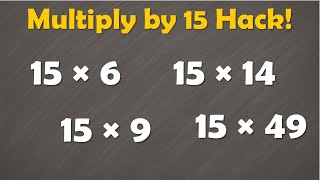
×15 is ×10 plus half

Also called Multiply by 15 trick · Ten plus half

General mental math

Use it when

Times 15 is times 10 plus half of that. Do ten of the number, then add half of it again.

How it works

To times by 15, times by 10 and add half of that. 13 × 15 is 130 + 65, which makes 195.

Worked examples

BoardFastest next stepAnswer
13 × 1513 × (10 + 5)= 195
13 × 15 = 195 and 13 × (10 + 5) = 195, same value.
37 × 1537 × (10 + 5)= 555
37 × 15 = 555 and 37 × (10 + 5) = 555, same value.
15 × 175(10 + 5) × 175= 2,625
15 × 175 = 2,625 and (10 + 5) × 175 = 2,625, same value.
15 × 57(10 + 5) × 57= 855
15 × 57 = 855 and (10 + 5) × 57 = 855, same value.

When it doesn't fit

  • 14 × 15 14 is even, so halve it and double 15.Instead: 7 × 30 (Halve and double)
  • 15 × 19 19 is 1 away from 20.Instead: 15 × (20 − 1) (Near-round multiplier)

The long way

Column multiplication: 13 × 5 = 65 on the first row, 13 × 10 = 130 on the next row, then 65 + 130 = 195.

Something off with this method? Tell us
What's wrong?

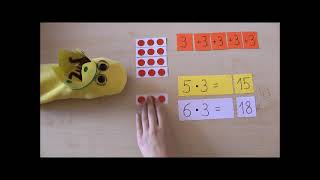
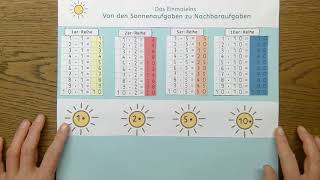
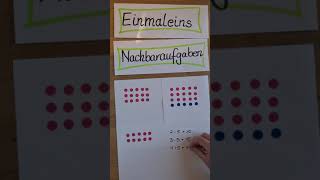
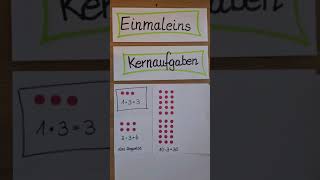
Neighbor fact (derive from ×5 and ×10)

Also called Nachbaraufgaben · Kernaufgaben / Königsaufgaben · Derived facts · Use a known fact

German Grundschule Einmaleins

Use it when

For a tricky times-table fact with a 6 or a 9, use the easy fact next door: 6 is 5 + 1 and 9 is 10 − 1.

How it works

If you know 5 times a number, 6 times it is just one more of that number. 6 × 7 is 35 + 7 = 42.

Worked examples

BoardFastest next stepAnswer
6 × 3(5 + 1) × 3= 18
6 × 3 = 18 and (5 + 1) × 3 = 18, same value.
6 × 7(5 + 1) × 7= 42
6 × 7 = 42 and (5 + 1) × 7 = 42, same value.
8 × 68 × (5 + 1)= 48
8 × 6 = 48 and 8 × (5 + 1) = 48, same value.
9 × 7(10 − 1) × 7= 63
9 × 7 = 63 and (10 − 1) × 7 = 63, same value.

When it doesn't fit

  • 6 × 5 5 is a core fact already.Instead: 30 (recall the core fact)
  • 6 × 6 Squares are recalled.Instead: 36 (recall the square)

The long way

Recall the times-table fact or skip-count: 3, 6, 9, 12, 15, 18, so 6 × 3 = 18.

Something off with this method? Tell us
What's wrong?

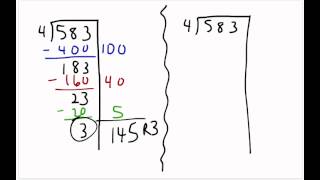
Partial quotients (split the dividend)

Also called Chunking · Big 7 / Lucky 7 · Distributive division

Common Core 4.NBT.6 / Everyday MathematicsUK chunking

Use it when

Break the big number into a tens chunk and a small chunk that the divisor goes into easily, then divide each piece.

How it works

Break the big number into pieces your divisor goes into easily, like 72 = 60 + 12. Divide each piece, then add the answers: 20 + 4 = 24.

Worked examples

BoardFastest next stepAnswer
72 ÷ 3(60 + 12) ÷ 3= 24
72 ÷ 3 = 24 and (60 + 12) ÷ 3 = 20 + 4 = 24, same value.
91 ÷ 7(70 + 21) ÷ 7= 13
91 ÷ 7 = 13 and (70 + 21) ÷ 7 = 10 + 3 = 13, same value.
846 ÷ 9(810 + 36) ÷ 9= 94
846 ÷ 9 = 94 and (810 + 36) ÷ 9 = 90 + 4 = 94, same value.
581 ÷ 7(560 + 21) ÷ 7= 83
581 ÷ 7 = 83 and (560 + 21) ÷ 7 = 80 + 3 = 83, same value.

When it doesn't fit

  • 56 ÷ 7 The answer is a times-table fact.Instead: 8 (recall 7 × 8 = 56)
  • 96 ÷ 4 The divisor is even, so halve both first.Instead: 48 ÷ 2 (Halve both first)

The long way

Long division: 3 goes into 7 tens 2 times with 1 left; bring down the 2 to make 12; 12 ÷ 3 = 4, so 24.

Something off with this method? Tell us
What's wrong?

Teens times teens (add on the ones, then multiply the ones)

Use it when

For two teen numbers, add the second one's ones digit onto the first and make it tens, then add the two ones digits multiplied.

How it works

For two teen numbers, add the second one's ones digit to the first and make that tens, then add the two ones digits multiplied: 13 × 14 is 170 + 12, which is 182.

Worked examples

BoardFastest next stepAnswer
13 × 14(13 + 4) × 10 + 3 × 4= 182
13 × 14 = 182 and 170 + 12 = 182, same value.
16 × 18(16 + 8) × 10 + 6 × 8= 288
16 × 18 = 288 and 240 + 48 = 288, same value.
14 × 17(14 + 7) × 10 + 4 × 7= 238
14 × 17 = 238 and 210 + 28 = 238, same value.
17 × 18(17 + 8) × 10 + 7 × 8= 306
17 × 18 = 306 and 250 + 56 = 306, same value.

When it doesn't fit

  • 14 × 16 4 + 6 = 10, so same-tens wins.Instead: 1 × 2 × 100 + 4 × 6 (Same tens, ones make 10)
  • 16 × 19 19 is 1 away from 20.Instead: 16 × (20 − 1) (Near-round multiplier)

The long way

Split by place value and multiply each part: 13 × 14 → 13 × 10 + 13 × 4 = 130 + 52 = 182.

Something off with this method? Tell us
What's wrong?

Multiply by a multiple of 10 (pull out the zeros)

Use it when

Take the zeros off, multiply the small numbers, then put the zeros back on.

How it works

Take the zeros off, multiply the small numbers, then stick the zeros back on: 30 × 23 is 3 × 23 = 69, plus one zero, which makes 690.

Worked examples

BoardFastest next stepAnswer
30 × 233 × 10 × 23= 690
30 × 23 = 690 and 3 × 10 × 23 = 690, same value.
400 × 74 × 100 × 7= 2,800
400 × 7 = 2,800 and 4 × 100 × 7 = 2,800, same value.
120 × 412 × 10 × 4= 480
120 × 4 = 480 and 12 × 10 × 4 = 480, same value.
40 × 60040 × 6 × 100= 24,000
40 × 600 = 24,000 and 40 × 6 × 100 = 24,000, same value.

When it doesn't fit

  • 50 × 46 46 is even, so halve it and make 100.Instead: 23 × 100 (×50 is half of ×100)
  • 100 × 37 100 is a power of ten, so just add zeros.Instead: 3700 (Powers of 10: shift the point)

The long way

Split by place value and multiply each part: 30 × 23 → 30 × 20 + 30 × 3 = 600 + 90 = 690.

Something off with this method? Tell us
What's wrong?

Cancel a common factor in a division

Also called Divide both by the same number · Equivalent division problems · Quotient-invariance property (商不变的性质) · わり算のきまり (わられる数とわる数を同じ数でわっても商は変わらない)

Chinese grade 4 textbook: 商不变的性质 / 商不变的规律Japanese grade 4: わり算のきまりとくふうUS/Common Core: equivalent division problems / compensation for divisionGrade 5-6 divisibility rules (digit sum for 3 and 9, last digit 0/5 for 5)

Use it when

If both numbers can be split by 3, 5, 6 or 9 to leave a one-digit divisor, split them first. Then the division is easy.

How it works

135 and 15 both end in 5, so split both by 5 first: 27 ÷ 3 is just 9.

Worked examples

BoardFastest next stepAnswer
135 ÷ 1527 ÷ 3= 9
135 ÷ 15 = 9 and 27 ÷ 3 = 9, same value; g = 5 is the largest allowed.
189 ÷ 2163 ÷ 7= 9
189 ÷ 21 = 9 and 63 ÷ 7 = 9, same value.
432 ÷ 2748 ÷ 3= 16
432 ÷ 27 = 16 and 48 ÷ 3 = 16, same value; g = 9.
378 ÷ 4263 ÷ 7= 9
378 ÷ 42 = 9 and 63 ÷ 7 = 9, same value; g = 6.

When it doesn't fit

  • 126 ÷ 18 Both even, and halving 18 gives a single digit.Instead: 63 ÷ 9 (Halve both first)
  • 221 ÷ 17 17 is prime, so nothing cancels.Instead: 13 (textbook long division)

The long way

Long division by the 2-digit divisor: how many 15s fit in 135? 15 × 9 = 135, so 9.

Something off with this method? Tell us
What's wrong?

Order of Operations

When the rules say "brackets first", sometimes there is a quicker legal move. 3 methods

Spread to make a round number

Also called Distributive property over a bracket · Expand to clear denominators

Common Core 6.EE.3General mental math

Use it when

When the number outside the brackets turns one number inside into a round number like 100 or 1000, multiply each part on its own first, then add or subtract.

How it works

4 × 25 is 100, so split the bracket: 4 × 25 is 100 and 4 × 6 is 24. Then 100 + 24 is 124.

Worked examples

BoardFastest next stepAnswer
4 × (25 + 6)100 + 24= 124
4 × 25 = 100 (round), 4 × 6 = 24; 100 + 24 = 124; textbook 4 × 31 = 124.
8 × (125 − 3)1000 − 24= 976
8 × 125 = 1000, 8 × 3 = 24; 1000 − 24 = 976; textbook 8 × 122 = 976.
4 × (75 + 3)300 + 12= 312
4 × 75 = 300, 4 × 3 = 12; 300 + 12 = 312; textbook 4 × 78 = 312. 75 + 3 needs no carry.
8 × (250 + 4)2000 + 32= 2032
8 × 250 = 2000, 8 × 4 = 32; 2000 + 32 = 2032; textbook 8 × 254 = 2032. 250 + 4 needs no carry.

When it doesn't fit

  • 4 × (26 + 14) The bracket already adds up to a round number (40), so adding inside first is faster than spreading into 104 + 56 (E1).Instead: 4 × 40
  • 7 × (13 + 5) 7 × 13 = 91 and 7 × 5 = 35, so neither part turns round. Spreading saves nothing (E2).Instead: 7 × 18

The long way

Do the bracket first: 4 × (25 + 6) → 4 × 31, then 124.

Something off with this method? Tell us
What's wrong?

Take out the common factor

Also called 分配のきまり · Reverse distributive · Factor out the GCF · ab + ac = a(b + c)

Japanese grade 4 計算のきまりCommon Core 6.NS.4 / 6.EE.3

Use it when

When two parts are multiplied by the same number, add (or take away) the other numbers first to get a round number, then do just one easy multiply.

How it works

Both parts are times 7, so add 23 + 77 first to get 100. Then 100 × 7 is just 700.

Worked examples

BoardFastest next stepAnswer
23 × 7 + 77 × 7(23 + 77) × 7= 700
23 + 77 = 100, 100 × 7 = 700; textbook 161 + 539 = 700.
46 × 25 + 54 × 25(46 + 54) × 25= 2500
46 + 54 = 100, 100 × 25 = 2500; textbook 1150 + 1350 = 2500.
138 × 47 − 38 × 47(138 − 38) × 47= 4700
138 − 38 = 100, 100 × 47 = 4700; textbook 6486 − 1786 = 4700.
99 × 6 + 6(99 + 1) × 6= 600
The bare 6 counts as 1 × 6; 99 + 1 = 100, 100 × 6 = 600; textbook 594 + 6 = 600.

When it doesn't fit

  • 3 × 7 + 3 × 8 3 is shared, but 7 + 8 = 15 is not round, so gathering gives 15 × 3, which is no easier (E2). Answer 45.Instead: 21 + 3 × 8 (tie: 3 × 7 + 24)
  • 2 × 7 + 8 × 3 2 + 8 = 10 looks tempting, but the products share no number (7 and 3), so there is nothing to gather (E1). Answer 38.Instead: 14 + 8 × 3 (tie: 2 × 7 + 24)

The long way

Multiply first, then add: 23 × 7 = 161 and 77 × 7 = 539, then 161 + 539 = 700.

Something off with this method? Tell us
What's wrong?

Cancel across × and ÷

Also called Cancellation · Divide out common factors first · Divide first, then multiply · 带符号搬家 (move with the sign: a×b÷c = a÷c×b)

Standard curriculum worldwideChinese primary 简便运算 (grade 3-4 '带符号搬家' for × and ÷)US/UK cancelling before multiplying

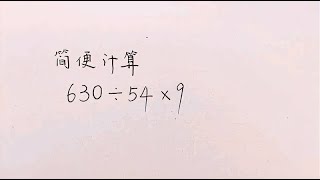
Use it when

In a times-and-divide problem, if the number you divide by goes into one of the numbers you multiply, or shares a times-table factor with it, knock that part out first so the numbers get small.

How it works

27 ÷ 9 is 3, so knock out the 9 first. Then 8 × 3 is just 24.

Worked examples

BoardFastest next stepAnswer
8 × 27 ÷ 98 × 3= 24
9 divides 27 (not 8): 27 ÷ 9 = 3, 8 × 3 = 24; textbook 8 × 27 = 216, 216 ÷ 9 = 24.
16 × 35 ÷ 716 × 5= 80
7 divides 35 (not 16): 35 ÷ 7 = 5, 16 × 5 = 80; textbook 16 × 35 = 560, 560 ÷ 7 = 80.
7 ÷ 4 × 127 × 3= 21
4 does not divide 7 but divides 12: 12 ÷ 4 = 3, 7 × 3 = 21; textbook 7 ÷ 4 = 1.75, 1.75 × 12 = 21.
14 × 15 ÷ 614 × 5 ÷ 2= 35
6 divides neither; it shares 3 with 15 and only 2 with 14, so cancel 3: 14 × 5 ÷ 2 → 7 × 5 = 35; textbook 14 × 15 = 210, 210 ÷ 6 = 35.

When it doesn't fit

  • 6 ÷ 3 × 7 Going left to right already divides first and comes out exact, so the textbook step is the same as cancelling (E2). Answer 14.Instead: 2 × 7
  • 3 × 7 ÷ 2 2 shares no factor with 3 or 7, so nothing can cancel, and 3 × 7 is a known fact anyway (E3, E4). Answer 10.5.Instead: 21 ÷ 2

The long way

Work left to right: 8 × 27 = 216, then 216 ÷ 9 = 24.

Something off with this method? Tell us
What's wrong?

Fractions

Fewer big denominators, more cancelling. 11 methods

Scale just one denominator

Also called The larger denominator is the LCD · Convert one fraction only

UK Year 5-6Common Core 5.NF.1

Use it when

When one bottom number fits exactly into the other, change only the fraction with the smaller bottom so both bottoms match.

How it works

The small bottom number fits right into the big one, so change only the smaller fraction to match the big bottom, then add the tops.

Worked examples

BoardFastest next stepAnswer
3/4 + 5/129/12 + 5/12= 7/6
3/4 = 9/12 (×3). 9 + 5 = 14, so 14/12 = 7/6. Decimal check: 0.75 + 0.41667 = 1.16667 = 7/6.
7/9 − 11/3628/36 − 11/36= 17/36
7/9 = 28/36 (×4). 28 − 11 = 17, giving 17/36, already lowest terms. Decimal check: 0.77778 − 0.30556 = 0.47222 = 17/36.
13/250 + 371/100052/1000 + 371/1000= 423/1000
13/250 = 52/1000 (×4). 52 + 371 = 423, giving 423/1000 = 0.423. Check: 0.052 + 0.371 = 0.423.
4567/12500 − 1233/250009134/25000 − 1233/25000= 7901/25000
4567/12500 = 9134/25000 (×2). 9134 − 1233 = 7901, giving 7901/25000 (odd, not ending in 5, so lowest terms). Decimal check: 0.36536 − 0.04932 = 0.31604.

When it doesn't fit

  • 1/4 + 1/6 6 is not a multiple of 4, so both fractions have to change. They also share a factor of 2, so Butterfly method does not fit either. Textbook common bottom.Instead: 3/12 + 2/12 (rewrite both over 12), then 5/12
  • 4/12 + 1/3 4/12 is not in lowest terms. Simplifying it makes the bottoms equal at once, which beats scaling 1/3 up to twelfths.Instead: 1/3 + 1/3 (cancel 4 from 4/12), then 2/3

The long way

3/4 + 5/12 → 36/48 + 20/48 (multiply the bottoms, 4 × 12 = 48, and rewrite both fractions), then 56/48 = 7/6.

Something off with this method? Tell us
What's wrong?

Cancel before multiplying

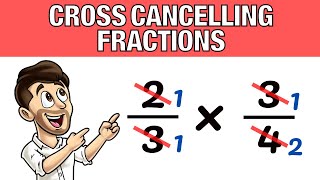
Also called Cross-cancelling · Simplify before you multiply

Common Core grade 5-6Universal

Use it when

When you multiply fractions, first cross out any number that fits into both a top and a bottom, so the numbers you multiply stay small.

How it works

Before you multiply, cross out a number that fits into both a top and a bottom. Small numbers are quicker to multiply.

Worked examples

BoardFastest next stepAnswer
7/10 × 5/97/2 × 1/9= 7/18
5 cancels from 5 and 10. 7 × 1 = 7 and 2 × 9 = 18, giving 7/18. Check: 35/90 = 7/18.
8/15 × 25/368/3 × 5/36= 10/27
Pairs are 25 with 15 (shared 5) and 8 with 36 (shared 4); 5 is larger, so cancel it first. Then cancel 4: 2/3 × 5/9 = 10/27. Check: 200/540 = 10/27.
48/125 × 375/6448/1 × 3/64= 9/4
375 and 125 share 125 (bigger than the 16 shared by 48 and 64). Then cancel 16: 3/1 × 3/4 = 9/4. Check: 18000/8000 = 9/4.
14 × 5/212 × 5/3= 10/3
21 does not go into 14, so this is not Fraction of a number: divide first, but 14 and 21 share 7. 2 × 5/3 = 10/3. Check: 70/21 = 10/3.

When it doesn't fit

  • 2/3 × 5/7 No top shares a factor with any bottom, so there is nothing to cancel.Instead: 10/21 (multiply tops and bottoms straight across)
  • 5/6 + 1/4 This is addition. Cancelling the 2 between 6 and 4 across a + sign would change the value.Instead: 10/12 + 3/12 (rewrite both over 12), then 13/12

The long way

Multiply straight across: 7/10 × 5/9 → 35/90, then simplify to 7/18.

Something off with this method? Tell us
What's wrong?

Fraction of a number: divide first

Also called Divide by the bottom, times by the top · Fraction of an amount

UK primary fractions of amountsUS grade 3-5

Use it when

To find a fraction of a whole number, divide the number by the bottom first, then multiply by the top.

How it works

Find 3/4 of 48 by splitting 48 into 4 equal parts first. One part is 12, and three parts are 36.

Worked examples

BoardFastest next stepAnswer
3/4 × 483 × 12= 36
48 ÷ 4 = 12, then 3 × 12 = 36. Check: 3 × 48 = 144 and 144 ÷ 4 = 36.
2/3 × 272 × 9= 18
27 ÷ 3 = 9, then 2 × 9 = 18. Check: 54 ÷ 3 = 18.
5/8 × 9605 × 120= 600
960 ÷ 8 = 120, then 5 × 120 = 600. Check: 4800 ÷ 8 = 600.
7/12 × 84,0007 × 7,000= 49,000
84,000 ÷ 12 = 7,000, then 7 × 7,000 = 49,000. Check: 12 × 49,000 = 588,000 = 7 × 84,000.

When it doesn't fit

  • 3/4 × 37 4 does not go into 37 and they share no factor, so there is nothing to divide first.Instead: 111/4 (multiply the top by 37), then 27 3/4
  • 2/5 × 3 The whole number 3 is smaller than the bottom 5, so 5 cannot divide it.Instead: 6/5 (multiply the top by 3), then 1 1/5

The long way

3/4 × 48 → 144/4 (multiply the top by 48 first), then 144 ÷ 4 = 36.

Something off with this method? Tell us
What's wrong?

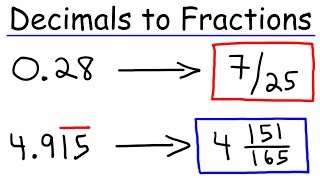
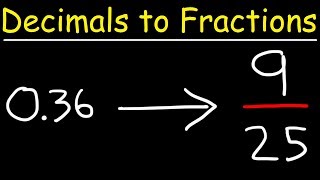
Turn the decimal into a matching fraction

General

Use it when

When a decimal is secretly a simple fraction whose bottom fits the other fraction's bottom, change the decimal into that fraction.

How it works

0.125 is really 1/8, and the other fraction is in eighths too, so switch the decimal to 1/8 and just add the tops.

Worked examples

BoardFastest next stepAnswer
0.125 + 3/81/8 + 3/8= 1/2
1/8 + 3/8 = 4/8 = 1/2. Decimal check: 3/8 = 0.375 and 0.125 + 0.375 = 0.5.
0.6 − 1/153/5 − 1/15= 8/15
3/5 = 9/15, 9/15 − 1/15 = 8/15. Decimal check: 0.6 − 0.0667 = 0.5333 = 8/15.
0.75 ÷ 3/83/4 ÷ 3/8= 2
3/4 ÷ 3/8 = 3/4 × 8/3 = 24/12 = 2. Decimal check: 0.75 ÷ 0.375 = 2.
0.4 × 5/82/5 × 5/8= 1/4
Cancel 5 and then 2: 1/1 × 1/4 = 1/4. Decimal check: 0.4 × 0.625 = 0.25.

When it doesn't fit

  • 0.3 + 1/2 1/2 is a one-place decimal, so turning it into 0.5 is just as quick, and 3/10 does not match the bottom 2 anyway.Instead: 0.3 + 0.5 (split 1/2 = 0.5), then 0.8
  • 0.7 + 1/3 0.7 is 7/10, and 10 does not fit into 3, so there is no matching fraction.Instead: 7/10 + 1/3 → 21/30 + 10/30 (common bottom 30), then 31/30
The long way

0.125 + 3/8 → 0.125 + 0.375 (turn 3/8 into a decimal by long division, 3 ÷ 8), then 0.5.

Something off with this method? Tell us
What's wrong?

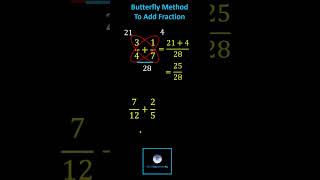
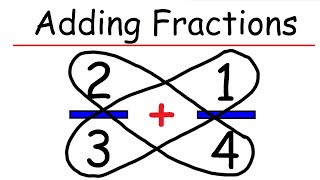
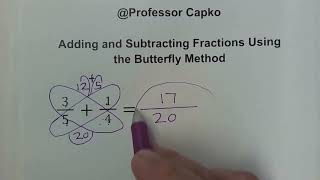
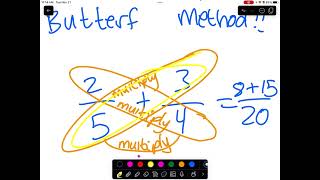
Butterfly method

Also called Criss-cross method · Cross-multiply to add fractions

US classroom trickGeneral mental math

Use it when

When the two bottom numbers share no factor, multiply across in an X to get the new tops, multiply the bottoms for the new bottom, then add or subtract the tops.

How it works

The bottoms 3 and 4 share nothing, so Cross-multiply a proportion: 1 × 4 and 3 × 1 make the new tops, 3 × 4 makes the bottom, then add the tops.

Worked examples

BoardFastest next stepAnswer
1/3 + 1/4(4 + 3)/12= 7/12
1×4 = 4, 3×1 = 3, 3×4 = 12. 4 + 3 = 7, giving 7/12. Check: 0.3333 + 0.25 = 0.5833 = 7/12.
5/7 − 2/9(45 − 14)/63= 31/63
5×9 = 45, 7×2 = 14, 7×9 = 63. 45 − 14 = 31, giving 31/63. Check: 0.71429 − 0.22222 = 0.49206 = 31/63.
37/64 − 19/81(2997 − 1216)/5184= 1781/5184
37×81 = 2997, 64×19 = 1216, 64×81 = 5184. 2997 − 1216 = 1781 (odd, digit sum 17, so no factor 2 or 3). Check: 0.578125 − 0.234568 = 0.343557.
123/100 + 45/77(9471 + 4500)/7700= 13971/7700
123×77 = 9471, 100×45 = 4500, 100×77 = 7700. 9471 + 4500 = 13971, not divisible by 2, 5, 7 or 11. Check: 1.23 + 0.584416 = 1.814416.

When it doesn't fit

  • 1/6 + 1/4 6 and 4 share a factor of 2, so 6 × 4 = 24 is bigger than the smallest common bottom 12.Instead: 2/12 + 3/12 (rewrite both over 12), then 5/12
  • 2/3 × 4/5 This is multiplication, not adding or subtracting.Instead: 8/15 (multiply tops and bottoms straight across)

The long way

Rewrite both fractions over 12 first: 1/3 + 1/4 → 4/12 + 3/12, then 7/12.

Something off with this method? Tell us
What's wrong?

Keep-change-flip

Also called Multiply by the reciprocal · Invert and multiply

Common Core 5.NF.7 / 6.NS.1Universal

Use it when

To divide by a fraction, keep the first number, change ÷ to ×, and flip the second fraction upside down.

How it works

Dividing by 4/5 is the same as multiplying by 5/4. Keep the first fraction, change the sign, flip the second.

Worked examples

BoardFastest next stepAnswer
2/3 ÷ 4/52/3 × 5/4= 5/6
2/3 × 5/4 = 10/12 = 5/6. Check: 5/6 × 4/5 = 20/30 = 2/3.
3/4 ÷ 2/73/4 × 7/2= 21/8
3 × 7 = 21 and 4 × 2 = 8, giving 21/8. Check: 21/8 × 2/7 = 42/56 = 3/4.
15/16 ÷ 25/3615/16 × 36/25= 27/20
Cancel 5 (15 and 25) and 4 (36 and 16): 3/4 × 9/5 = 27/20. Check: 27/20 × 25/36 = 675/720 = 15/16.
6 ÷ 2/56 × 5/2= 15
6 × 5/2 = 30/2 = 15. Check: 15 × 2/5 = 6.

When it doesn't fit

  • 8/9 ÷ 2/3 2 goes into 8 and 3 goes into 9, so one straight-across division finishes it.Instead: 4/3 (divide tops and bottoms straight across: 8 ÷ 2 and 9 ÷ 3)
  • 1 1/2 ÷ 3/4 The dividend is a mixed number, so it must become an improper fraction first.Instead: 3/2 ÷ 3/4 (change the mixed number to an improper fraction)

The long way

Rewrite both over a common bottom: 2/3 ÷ 4/5 → 10/15 ÷ 12/15, then divide the tops, 10 ÷ 12 = 5/6.

Something off with this method? Tell us
What's wrong?

Same denominator: divide the tops

Also called Common denominator method for dividing fractions

Common Core 6.NS.1

Use it when

When both fractions have the same bottom number, cross out the bottoms and just divide the top numbers.

How it works

Both fractions are in eighths, so 6 eighths divided by 3 eighths is just 6 ÷ 3.

Worked examples

BoardFastest next stepAnswer
6/8 ÷ 3/86 ÷ 3= 2
6 ÷ 3 = 2. Check: 6/8 × 8/3 = 48/24 = 2.
5/12 ÷ 7/125 ÷ 7= 5/7
5 ÷ 7 = 5/7. Check: 5/12 × 12/7 = 60/84 = 5/7.
840/13 ÷ 12/13840 ÷ 12= 70
840 ÷ 12 = 70. Check: 12 × 70 = 840.
98000/250 ÷ 3500/25098000 ÷ 3500= 28
98000 ÷ 3500 = 980 ÷ 35 = 28. Check: 3500 × 28 = 98000; also 392 ÷ 14 = 28.

When it doesn't fit

  • 2 1/4 ÷ 3/4 2 1/4 is a mixed number. Cancelling the 4s now would give a wrong answer.Instead: 9/4 ÷ 3/4 (change the mixed number to an improper fraction)
  • 5/12 ÷ 7 The divisor is a whole number, not a fraction with the same bottom.Instead: 5/12 × 1/7, then 5/84

The long way

Keep-change-flip: 6/8 ÷ 3/8 → 6/8 × 8/3, then 48/24 = 2.

Something off with this method? Tell us
What's wrong?

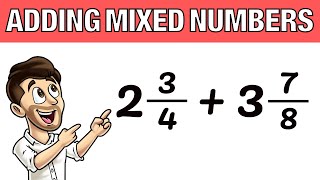
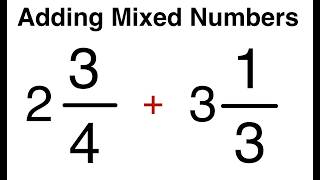
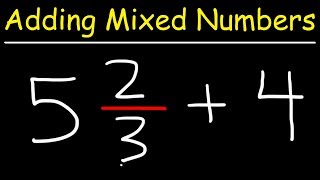
Add wholes and fractions separately

Also called Partitioning mixed numbers · Breaking apart mixed numbers

US grade 4-5UK Year 5-6

Use it when

When adding mixed numbers, add the whole numbers first, then add the little fraction parts.

How it works

Add the big whole numbers first, then add the small fraction pieces, then put them together.

Worked examples

BoardFastest next stepAnswer
3 1/2 + 2 1/45 + 1/2 + 1/4= 5 3/4
3 + 2 = 5; 1/2 + 1/4 = 3/4; 5 3/4. Check: 7/2 + 9/4 = 23/4 = 5.75.
12 1/3 + 25 1/637 + 1/3 + 1/6= 37 1/2
12 + 25 = 37; 2/6 + 1/6 = 3/6 = 1/2; 37 1/2. Check: 74/6 + 151/6 = 225/6 = 37.5.
468 2/9 + 1357 5/91825 + 2/9 + 5/9= 1825 7/9
468 + 1357 = 1825; 2/9 + 5/9 = 7/9. Check: 1825.7778 = 16432/9.
45678 1/8 + 23456 3/469134 + 1/8 + 3/4= 69134 7/8
45678 + 23456 = 69134; 1/8 + 6/8 = 7/8. Check: 0.125 + 0.75 = 0.875.

When it doesn't fit

  • 2 1/3 + 1/3 Only one term has a whole part, so there are no whole parts to put together.Instead: 2 2/3 (combine the fractions 1/3 + 1/3)
  • 2 3/4 + 1 1/2 3/4 + 1/2 is more than 1, so the fraction parts carry into the wholes.Instead: 11/4 + 3/2 (change both to improper fractions), then 17/4 = 4 1/4

The long way

Change each mixed number to an improper fraction: 3 1/2 + 2 1/4 → 7/2 + 9/4, then 14/4 + 9/4 = 23/4 = 5 3/4.

Something off with this method? Tell us
What's wrong?

Distribute over a mixed number

Use it when

To multiply a whole number by a mixed number, multiply the whole part and the fraction part separately, then add them.

How it works

8 lots of 3 is 24, and 8 lots of a quarter is 2, so 8 × 3 1/4 is 26.

Worked examples

BoardFastest next stepAnswer
8 × 3 1/48×3 + 8×1/4= 26
24 + 2 = 26 (4 goes into 8). Check: 8 × 13/4 = 104/4 = 26.
6 × 7 1/36×7 + 6×1/3= 44
42 + 2 = 44 (3 goes into 6). Check: 6 × 22/3 = 132/3 = 44.
2 × 4 1/52×4 + 2×1/5= 8 2/5
8 + 2/5 = 8 2/5 (2 × 1 = 2 is less than 5). Check: 2 × 21/5 = 42/5.
3 × 5 2/73×5 + 3×2/7= 15 6/7
15 + 6/7 = 15 6/7 (3 × 2 = 6 is less than 7). Check: 3 × 37/7 = 111/7.

When it doesn't fit

  • 3 × 2 3/4 4 does not go into 3, and 3 × 3 = 9 is not less than 4, so splitting leaves 6 + 9/4, which still needs converting.Instead: 3 × 11/4 (change the mixed number), then 33/4 = 8 1/4
  • 2 1/2 × 1 1/3 Both factors are mixed numbers, so there is no whole-number multiplier.Instead: 5/2 × 4/3 (change both to improper fractions), then 10/3 = 3 1/3

The long way

Change 3 1/4 into the improper fraction 13/4, so 8 × 3 1/4 → 8 × 13/4, then 104/4 = 26.

Something off with this method? Tell us
What's wrong?

Pair fractions to a whole

Also called Make a whole · Fractions that make one · Use properties to add fractions (commutative/associative regrouping)

Singapore MathCommon Core / Go Math (Use Properties to Add Fractions)General mental math

Use it when

In a long sum, if two fractions with the same bottom add up to exactly 1, put them together first, even if they are not next to each other.

How it works

3/8 and 5/8 make one whole, so put them together first and the hard part disappears.

Worked examples

BoardFastest next stepAnswer
3/8 + 4/5 + 5/81 + 4/5= 1 4/5
3/8 + 5/8 = 1, then 1 + 4/5 = 1 4/5. Check in 40ths: 15 + 32 + 25 = 72, 72/40 = 9/5.
3/5 − 1/4 + 2/51 − 1/4= 3/4
3/5 + 2/5 = 1, then 1 − 1/4 = 3/4. Check in 20ths: 12 − 5 + 8 = 15, 15/20 = 3/4.
1/6 + 3/4 + 5/6 + 1/21 + 3/4 + 1/2= 2 1/4
1/6 + 5/6 = 1, then 1 + 3/4 + 2/4 = 2 1/4. Check in 12ths: 2 + 9 + 10 + 6 = 27, 27/12 = 9/4.
1/3 + 2 3/4 + 2/31 + 2 3/4= 3 3/4
1/3 + 2/3 = 1, then 1 + 2 3/4 = 3 3/4. Check in 12ths: 4 + 33 + 8 = 45, 45/12 = 15/4.

When it doesn't fit

  • 3/8 + 5/8 + 4/5 The pair that makes 1 is already the first two terms, so ordinary left-to-right does the same thing.Instead: 1 + 4/5 (add the first two fractions left to right)
  • 7/9 + 1/2 − 2/9 7/9 and 2/9 share a bottom, but 2/9 is taken away, and 7/9 − 2/9 is not 1.Instead: 14/18 + 9/18 − 2/9 (rewrite 7/9 + 1/2 over 18)

The long way

Work left to right with a common bottom: 3/8 + 4/5 → 15/40 + 32/40 = 47/40, then add 5/8 = 25/40 to get 72/40 = 1 4/5.

Something off with this method? Tell us
What's wrong?

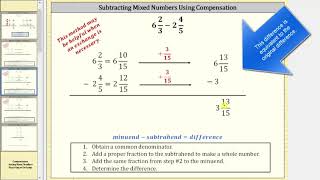
Round the subtracted mixed number

Also called Compensation with fractions · Mixed-number compensation (round to a whole) · Subtracting mixed numbers using the compensation method

US/Canadian compensation strategyCommon Core grade 4-5 fraction strategies

Use it when

When you take away a mixed number that is one piece short of the next whole number, and its fraction part is too big to take away directly, add that one piece to both numbers. Now you take away a whole number.

How it works

3 4/5 is just 1/5 less than 4. Add 1/5 to both numbers, and now you only take away 4.

Worked examples

BoardFastest next stepAnswer
7 1/5 − 3 4/57 2/5 − 4= 3 2/5
7 2/5 − 4 = 3 2/5. Check: 36/5 − 19/5 = 17/5 = 3 2/5.
6 − 2 3/46 1/4 − 3= 3 1/4
6 1/4 − 3 = 3 1/4. Check: 24/4 − 11/4 = 13/4.
9 2/7 − 4 6/79 3/7 − 5= 4 3/7
9 3/7 − 5 = 4 3/7. Check: 65/7 − 34/7 = 31/7.
10 3/8 − 5 7/810 4/8 − 6= 4 1/2
10 4/8 − 6 = 4 4/8 = 4 1/2. Check: 83/8 − 47/8 = 36/8 = 9/2.

When it doesn't fit

  • 8 5/6 − 3 1/6 5/6 is bigger than 1/6, so nothing needs borrowing.Instead: 5 4/6 (subtract wholes 8 − 3 and parts 5/6 − 1/6), then 5 2/3
  • 5 1/4 − 2 2/3 The bottoms 4 and 3 are different, so the fractions must share a bottom first.Instead: 5 3/12 − 2 8/12 (rewrite both fraction parts over 12)

The long way

Borrow a whole: 7 1/5 − 3 4/5 → 6 6/5 − 3 4/5, then subtract wholes and parts to get 3 2/5.

Something off with this method? Tell us
What's wrong?

Decimals & Percents

Percents as friendly fractions, decimals as whole numbers. 13 methods

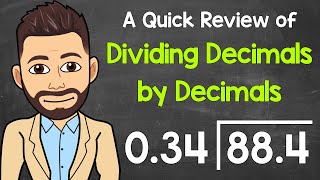
Make the divisor whole

Also called わる数を整数にする · Move the decimal point in both numbers · Clear the decimal divisor · Divide by 0.5 = double

Japanese grade 5 小数のわり算US grade 5-6UK KS2/3

Use it when

When you divide by a decimal, multiply both numbers by 10 or 100 until the number you divide by is whole. The answer does not change.

How it works

You are dividing by a decimal, so multiply both numbers by 10 until the number you divide by is whole. The answer stays the same: 68 ÷ 0.8 is the same as 680 ÷ 8.

Worked examples

BoardFastest next stepAnswer
4.2 ÷ 0.642 ÷ 6= 7
42 ÷ 6 = 7, and 7 × 0.6 = 4.2
68 ÷ 0.8680 ÷ 8= 85
680 ÷ 8 = 85, and 85 × 0.8 = 68
7.56 ÷ 0.12756 ÷ 12= 63
63 × 12 = 756, so 63 × 0.12 = 7.56
6 ÷ 0.05600 ÷ 5= 120
600 ÷ 5 = 120, and 120 × 0.05 = 6

When it doesn't fit

  • 7.2 ÷ 9 The divisor 9 is already whole, so there is nothing to scale.Instead: 0.8 (short division: 72 ÷ 9 = 8, then put the point back)
  • 4.2 ÷ 0.1 Dividing by 0.1 is a power of ten, so Powers of 10: shift the point owns it.Instead: 42 (Powers of 10: shift the point: slide the point one place right)

The long way

split both decimals into tenths and multiply by the flipped fraction: 4.2 ÷ 0.6 → 42/10 × 10/6. That takes more rewrites before you reach 42 ÷ 6 = 7.

Something off with this method? Tell us
What's wrong?

Swap the percent

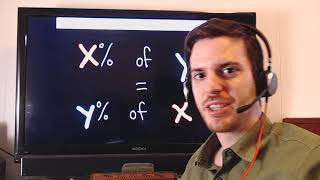
Also called x% of y = y% of x · Percentage flip · Percentages are reversible

General mental math (viral 2018)GCSE tip videos

Use it when

p% of N is the same as N% of p. Flip them when N is 20, 25, 50 or 75, because those percents are easy fractions.

How it works

16% of 25 is the same as 25% of 16. A quarter of 16 is 4, so the answer is 4.

Worked examples

BoardFastest next stepAnswer
16% of 2525% of 16= 4
A quarter of 16 is 4, and 0.16 × 25 = 4
36% of 5050% of 36= 18
Half of 36 is 18, and 0.36 × 50 = 18
48% of 7575% of 48= 36
48 ÷ 4 = 12, 12 × 3 = 36, and 0.48 × 75 = 36
35% of 2020% of 35= 7
35 ÷ 5 = 7, and 0.35 × 20 = 7

When it doesn't fit

  • 25% of 16 25% is already the easy percent, so Friendly percent as a fraction owns it.Instead: 1/4 × 16 (Friendly percent as a fraction)
  • 37% of 41 41 is not 20, 25, 50 or 75, so swapping makes nothing easier.Instead: 0.37 × 41 (textbook: percent to decimal), which is 15.17

The long way

split 16% into 0.16: 16% of 25 → 0.16 × 25.

Something off with this method? Tell us
What's wrong?

Friendly percent as a fraction

Also called Benchmark percents · 25% = 1/4 · 0.125 = 1/8

Common Core grade 6-7UK curriculumKhan Academy

Use it when

50%, 25%, 75%, 20% and 12.5% are easy fractions. Swap the percent for its fraction when the other number splits evenly.

How it works

25% is one quarter. To find 25% of 140, split 140 into 4 equal parts: 35.

Worked examples

BoardFastest next stepAnswer
25% of 1401/4 × 140= 35
140 ÷ 4 = 35, and 0.25 × 140 = 35
75% of 643/4 × 64= 48
64 ÷ 4 = 16, 16 × 3 = 48, and 0.75 × 64 = 48
0.2 × 351/5 × 35= 7
35 ÷ 5 = 7, and 0.2 × 35 = 7
80 + 25% of 8080 + 1/4 × 80= 100
80 ÷ 4 = 20, 80 + 20 = 100

When it doesn't fit

  • 25% of 37 37 does not split into 4 equal whole parts.Instead: 0.25 × 37 (textbook), which is 9.25
  • 40% of 80 40% now belongs to 10% then scale.Instead: 4 × 8 (10% then scale), which is 32

The long way

25% of 140 → 0.25 × 140 (write the percent as a decimal, then multiply).

Something off with this method? Tell us
What's wrong?

Pair decimals to a whole

Also called Compatible decimals · Make a whole

Compatible-numbers strategy

Use it when

Look for two added decimals whose ends make exactly 1, like .3 and .7, and add those two first so they become a whole number.

How it works

Find two decimals whose ends add to exactly 1, like .3 and .7. Add those two first so they turn into a whole number.

Worked examples

BoardFastest next stepAnswer
0.3 + 6.48 + 0.71 + 6.48= 7.48
Left to right: 0.3 + 6.48 = 6.78, then 6.78 + 0.7 = 7.48
2.35 + 16 + 4.657 + 16= 23
Left to right: 2.35 + 16 = 18.35, then 18.35 + 4.65 = 23
12.25 + 340.6 + 87.75100 + 340.6= 440.6
Left to right: 12.25 + 340.6 = 352.85, then 352.85 + 87.75 = 440.6
9.6 − 2 + 0.410 − 2= 8
Left to right: 9.6 − 2 = 7.6, then 7.6 + 0.4 = 8

When it doesn't fit

  • 6.48 − 0.3 + 0.7 0.3 is taken away, not added, so it cannot pair with 0.7.Instead: 6.18 + 0.7 (left to right), giving 6.88
  • 0.4 + 5.2 + 0.7 .4 and .7 make 1.1, not exactly 1.Instead: 5.6 + 0.7 (left to right), giving 6.3

The long way

Add left to right: 0.3 + 6.48 + 0.7 → 6.78 + 0.7.

Something off with this method? Tell us
What's wrong?

10% then scale

Also called 10% method · Find 10% first

UK/US non-calculator percentages

Use it when

Find 10% by moving the point one place left, then multiply by how many tens are in the percent. 40% of 60 is 4 lots of 6.

How it works

10% of 60 is 6. 40% is 4 lots of that, so 4 × 6 = 24.

Worked examples

BoardFastest next stepAnswer
40% of 604 × 6= 24
0.4 × 60 = 24
90% of 479 × 4.7= 42.3
47 − 4.7 = 42.3
60% of 4,2506 × 425= 2,550
4,250 ÷ 5 = 850, 850 × 3 = 2,550
20% of 372 × 3.7= 7.4
0.2 × 37 = 7.4

When it doesn't fit

  • 40% of 25 Swapping gives a quarter of 40, so Swap the percent owns it.Instead: 25% of 40 (Swap the percent), which is 10
  • 20% of 45 45 divides by 5, so 20% as one fifth is faster.Instead: 1/5 × 45 (Friendly percent as a fraction), which is 9

The long way

40% of 60 → 0.4 × 60 (change the percent to a decimal, then multiply).

Something off with this method? Tell us
What's wrong?

1% then scale

Also called 1% method

UK primary/KS3

Use it when

When N is a whole number of hundreds, 1% of N is easy: drop two zeros. Then multiply by the percent.

How it works

1% of 300 is 3 (drop two zeros). 7% is 7 lots of that, so 7 × 3 = 21.

Worked examples

BoardFastest next stepAnswer
7% of 3007 × 3= 21
300 × 7 = 2,100, then ÷ 100 = 21
3% of 8003 × 8= 24
800 × 3 = 2,400, then ÷ 100 = 24
6% of 4,5006 × 45= 270
10% is 450, 4% is 180, 450 − 180 = 270
15% of 40015 × 4= 60
10% is 40, 5% is 20, 40 + 20 = 60

When it doesn't fit

  • 7% of 350 350 is not a whole number of hundreds, so 1% is 3.5, a decimal.Instead: 0.07 × 350 (textbook), which is 24.5
  • 25% of 300 25% is a friendly percent, so Friendly percent as a fraction owns it.Instead: 1/4 × 300 (Friendly percent as a fraction), which is 75

The long way

7% of 300 → 0.07 × 300 (rewrite the percent as a decimal, then multiply).

Something off with this method? Tell us
What's wrong?

Percent change multiplier

Also called Multiplier method · Increase by 15% = × 1.15

UK GCSE (Corbettmaths)

Use it when

When you add or take away a percent of a number from that same number, do it as one multiply: adding 15% is times 1.15, taking away 12% is times 0.88.

How it works

Adding 15% to 80 is the same as 80 times 1.15. One multiply does the whole job.

Worked examples

BoardFastest next stepAnswer
80 + 15% of 8080 × 1.15= 92
15% of 80 is 12, and 80 + 12 = 92
250 − 12% of 250250 × 0.88= 220
12% of 250 is 30, and 250 − 30 = 220
4,800 increased by 10%, then decreased by 20%4,800 × 1.1 × 0.8= 4,224
4,800 + 480 = 5,280; 20% of 5,280 is 1,056; 5,280 − 1,056 = 4,224
62,500 − 36% of 62,50062,500 × 0.64= 40,000
36% of 62,500 is 22,500, and 62,500 − 22,500 = 40,000

When it doesn't fit

  • 80 + 15% of 60 The percent is of 60, not 80, so there is no shared number to gather.Instead: 80 + 0.15 × 60 (textbook), which ends at 89
  • 80 + 25% of 80 25% of 80 is a friendly piece, so Friendly percent as a fraction goes first.Instead: 80 + 1/4 × 80 (Friendly percent as a fraction), which ends at 100

The long way

80 + 15% of 80 → 80 + 12 (find the percent first, then add).

Something off with this method? Tell us
What's wrong?

Multiply decimals as whole numbers

Also called Ignore the decimal point · Count decimal places

Common Core grade 5-6Universal

Use it when

Hide the decimal points and do the times-table fact, then divide by 10 once for every digit that was after a point.

How it works

Hide the points: 3 × 4 = 12. There were two digits after points, so divide by 100 to get 0.12.

Worked examples

BoardFastest next stepAnswer
0.3 × 0.4(3 × 4) ÷ 100= 0.12
12 ÷ 100 = 0.12; two decimal places in, two out
0.06 × 0.7(6 × 7) ÷ 1000= 0.042
42 ÷ 1000 = 0.042; three decimal places in, three out
2.5 × 0.07(25 × 7) ÷ 1000= 0.175
3 × 1.2(3 × 12) ÷ 10= 3.6
36 ÷ 10 = 3.6, and 1.2 + 1.2 + 1.2 = 3.6

When it doesn't fit

  • 0.7 × 0.1 0.1 is a power of ten, so just slide the point.Instead: 0.07 (Powers of 10: shift the point)
  • 0.2 × 35 0.2 is one fifth and 35 divides by 5.Instead: 1/5 × 35 (Friendly percent as a fraction), which is 7

The long way

Write 0.3 × 0.4 in a column, multiply 3 × 4 = 12, then count the two decimal places back in to get 0.12.

Something off with this method? Tell us
What's wrong?

Powers of 10: shift the point

Also called Move the decimal point · × 10^n shift · Scientific notation expansion

UK KS2US grade 5 place valueCommon Core 8.EE.3-4

Use it when

When you times or divide by 10, 100 or 1000 (or 0.1, 0.01), just slide the decimal point one place for each zero.

How it works

Times 100 means slide the point 2 places right: 3.47 becomes 347.

Worked examples

BoardFastest next stepAnswer
3.47 × 100347= 347
347 ÷ 100 = 3.47
3 + 4.2 × 1003 + 420= 423
4.2 × 100 = 420, then 3 + 420 = 423
4.25 ÷ 10000.00425= 0.00425
0.00425 × 1000 = 4.25
86421 ÷ 0.018642100= 8,642,100
8,642,100 × 0.01 = 86,421

When it doesn't fit

  • 3.47 × 99 99 is near 100 but is not a power of ten.Instead: 3.47 × (100 − 1) (Near-round multiplier), ending at 343.53
  • 2 × 10 × 5 In a 3-factor chain with a friendly pair, Friendly pair first wins.Instead: 10 × 10 (Friendly pair first: 2 × 5 first), ending at 100

The long way

Multiply 347 × 100 = 34,700 as whole numbers, then count the 2 decimal places back in: 347.

Something off with this method? Tell us
What's wrong?

Make the denominator 10, 100 or 1000

Use it when

To turn a fraction into a decimal or percent, multiply top and bottom so the bottom becomes 10, 100 or 1000. Then you can read it straight off.

How it works

Times top and bottom by 4 so 25 turns into 100. 36 out of 100 is 36%.

Worked examples

BoardFastest next stepAnswer
9/25 = ?%36/100= 36%
9 × 4 = 36 and 25 × 4 = 100; 36 ÷ 100 = 0.36 = 36%
0.15 + 5/80.15 + 625/1000= 0.775
11/40 or 0.27: which is bigger?275/1000 or 0.27= 11/40 (0.275 > 0.27)
11 × 25 = 275 and 40 × 25 = 1000; 0.275 > 0.270
0.37 + 3/200.37 + 15/100= 0.52
3 × 5 = 15, so 3/20 = 0.15; 0.37 + 0.15 = 0.52

When it doesn't fit

  • 5/12 as a decimal 12 has a factor 3, so no 10, 100 or 1000 works.Instead: 5 ÷ 12 by long division, 0.41666... (textbook)
  • 0.4 + 7/20 0.4 is two fifths and 5 divides 20, so Turn the decimal into a matching fraction owns it.Instead: 2/5 + 7/20 (Turn the decimal into a matching fraction), ending at 0.75
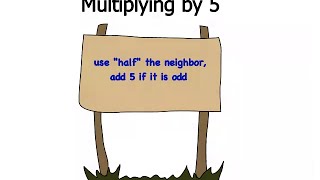

The long way

Divide the top by the bottom with long division: 9 ÷ 25 = 0.36, so 36%.
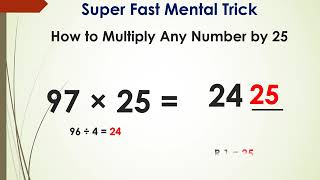
Something off with this method? Tell us
What's wrong?

Near-round decimal

Also called Price ending in .99 · 9.99 = 10 − 0.01 · Compensation for decimal multiplication · Round up and take back (decimals)

General mental mathUS Common Core grade 5-7 compensation strategyShopping / price mental math

Use it when

1.99 is just 1 cent less than 2. Times by 2 instead, then take back the little bit.

How it works

1.99 is 1 cent less than 2. Do 84 × 2 = 168, then take away 84 cents: 167.16.

Worked examples

BoardFastest next stepAnswer
84 × 1.9984 × (2 − 0.01)= 167.16
168 − 0.84 = 167.16; 84 × 199 = 16,716, two places → 167.16
6 × 4.996 × (5 − 0.01)= 29.94
30 − 0.06 = 29.94; 6 × 499 = 2,994
3 × 2.983 × (3 − 0.02)= 8.94
9 − 0.06 = 8.94; 3 × 298 = 894
14 × 0.4914 × (0.5 − 0.01)= 6.86
7 − 0.14 = 6.86; 14 × 49 = 686

When it doesn't fit

  • 7 × 3.02 3.02 is above 3, not just below a round number.Instead: 7 × (3 + 0.02) (Break apart a factor (partial products)), ending at 21.14
  • 10 × 2.99 Times 10 is one point slide.Instead: 29.9 (Powers of 10: shift the point)

The long way

Multiply in columns as whole numbers (84 × 199 = 16,716), then count two decimal places: 167.16.

Something off with this method? Tell us
What's wrong?

Halve and double decimals

Also called Double the .5, halve the even · Halving and doubling with decimals · Double and half strategy (decimals)

General mental mathNumber Talks / Bridges halving-and-doubling strategy (extended to decimals)Grade 6-7 decimal multiplication mental strategies

Use it when

Double the number ending in .5 so it becomes whole, and halve the other number. You get an easy times-table fact.

How it works

Double 4.5 to get 9, halve 16 to get 8. Now it is 9 × 8 = 72.

Worked examples

BoardFastest next stepAnswer
4.5 × 169 × 8= 72
45 × 16 = 720, one decimal place → 72
7.5 × 1415 × 7= 105
75 × 14 = 1,050, one decimal place → 105
1.2 × 1.50.6 × 3= 1.8
12 × 15 = 180, two decimal places → 1.8
2.5 × 0.85 × 0.4= 2
25 × 8 = 200, two decimal places → 2

When it doesn't fit

  • 0.5 × 18 0.5 with a whole partner is Friendly percent as a fraction's problem.Instead: 1/2 × 18 (Friendly percent as a fraction), which is 9
  • 3.5 × 7 7 is odd, so halving gives 3.5 and nothing gets easier.Instead: 7 × (3 + 0.5) (Break apart a factor (partial products)), ending at 24.5

The long way

Multiply the digits as whole numbers, then place the point: 45 × 16 = 720, one decimal place → 72.

Something off with this method? Tell us
What's wrong?

Build the percent from 10% and 5%

Also called Percent building blocks · 15% = 10% + 5% · Tip method · Using 10% as a base (non-calculator percentages)

General mental math (US restaurant tip method)UK non-calculator percentages (GCSE / KS2-KS3)

Use it when

To find 15%, 35%, 45%, 55% or 65%, split off 5%. 5% is half of 10%. So 15% of 60 is 10% (6) plus 5% (3), which is 9.

How it works

10% of 60 is 6. Half of that is 3, which is 5%. Add them: 15% of 60 is 9.

Worked examples

BoardFastest next stepAnswer
15% of 6010% of 60 + 5% of 60= 9
6 + 3 = 9, and 0.15 × 60 = 9
35% of 8030% of 80 + 5% of 80= 28
24 + 4 = 28, and 0.35 × 80 = 28
15% of 14010% of 140 + 5% of 140= 21
14 + 7 = 21, and 0.15 × 140 = 21
55% of 7050% of 70 + 5% of 70= 38.5
35 + 3.5 = 38.5, and 0.55 × 70 = 38.5

When it doesn't fit

  • 15% of 300 300 is a whole number of hundreds, so 1% is 3 and 1% then scale owns it.Instead: 15 × 3 (1% then scale), which is 45
  • 15% of 20 N is below 30, and swapping gives one fifth of 15.Instead: 20% of 15 (Swap the percent), which is 3

The long way

Change the percent to a decimal and multiply: 15% of 60 → 0.15 × 60.

Something off with this method? Tell us
What's wrong?

Powers & Roots

Squares you can do in your head and exponent rules that skip the multiplying. 9 methods

Combine roots first

Also called √a × √b = √ab

Algebra 1

Use it when

When two square roots are multiplied or divided and putting them together makes a square number, put them under one root first.

How it works

When two square roots are multiplied or divided, put them under one root first: √2 × √8 becomes √16, which is just 4.

Worked examples

BoardFastest next stepAnswer
√2 × √8√16= 4
2 × 8 = 16 and √16 = 4. Long way: √8 = 2√2, and √2 × 2√2 = 2 × 2 = 4.
√3 × √27√81= 9
3 × 27 = 81 and √81 = 9. Long way: √27 = 3√3, and √3 × 3√3 = 3 × 3 = 9.
√75 ÷ √3√25= 5
75 ÷ 3 = 25 and √25 = 5. Long way: √75 = 5√3, and 5√3 ÷ √3 = 5.
√98 ÷ √2√49= 7
98 ÷ 2 = 49 and √49 = 7. Long way: √98 = 7√2, and 7√2 ÷ √2 = 7.

When it doesn't fit

  • √9 × √16 9 and 16 are both square numbers, so working out each root is just as fast as making √144.Instead: 3 × √16 or √9 × 4 (tie), then 12
  • √6 × √10 6 × 10 = 60 is not a square number, so combining does not give a whole number right away. Neither root can be simplified on its own, so the plain textbook product step is next.Instead: √60, then simplify to 2√15

The long way

Simplify the root that can be simplified first: rewrite √8 as 2√2, so the problem becomes √2 × 2√2, then 2 × 2 = 4.

Something off with this method? Tell us
What's wrong?

Pull out the largest perfect square

Also called Simplifying radicals

Common Core grade 8 / Algebra 1

Use it when

Find the biggest square number hiding inside the number under the root and split it out, so you can take its root next.

How it works

Find the biggest square number hiding inside the number under the root, pull it out as its square root, and leave the rest inside: √72 = √(36 × 2) = 6√2.

Worked examples

BoardFastest next stepAnswer
√72√(36 × 2)= 6√2
36 × 2 = 72, 36 is the largest square factor of 72, √36 = 6, and 2 has no square factor, so 6√2. (6√2)² = 36 × 2 = 72.
√500√(100 × 5)= 10√5
100 × 5 = 500, and 500 = 2² × 5³ so 100 is the largest square factor. (10√5)² = 100 × 5 = 500.
√48√(16 × 3)= 4√3
16 × 3 = 48, and 48 = 2⁴ × 3 so 16 is the largest square factor. (4√3)² = 16 × 3 = 48.
√98√(49 × 2)= 7√2
49 × 2 = 98, and 98 = 2 × 7² so 49 is the largest square factor. (7√2)² = 49 × 2 = 98.

When it doesn't fit

  • √196 196 is already a square number (14 × 14), so there is nothing to split out. Just work out the root.Instead: 14
  • √8 + √18 Both roots can be simplified, so simplifying either one first is equally fast. That makes it a textbook tie, not one fastest method step.Instead: 2√2 + √18 or √8 + 3√2 (tie), then 5√2

The long way

Use a factor tree: √72 → √(2 × 2 × 2 × 3 × 3), pair up matching primes (2 · 2 and 3 · 3), and pull one of each pair out: 2 × 3 × √2 = 6√2.

Something off with this method? Tell us
What's wrong?

Square near 50

Also called Base-50 squaring · 25 ± d then append d²

Vedic (India) sub-baseGeneral mental math

Use it when

To square a number from 41 to 59, start from 25, move it by how far the number is from 50, put two zeros on the end, and add that distance times itself.

How it works

For a number close to 50, add how far it is above 50 to 25 (or take it away if the number is below 50), put two zeros on the end, then add that distance times itself: 47² is 22 hundreds plus 9, which makes 2209.

Worked examples

BoardFastest next stepAnswer
41²(25 − 9) × 100 + 9²= 1681
41 = 50 − 9. 16 × 100 = 1600, 9² = 81, 1600 + 81 = 1681. Long way: 41 × 41 = 1640 + 41 = 1681.
47²(25 − 3) × 100 + 3²= 2209
47 = 50 − 3. 22 × 100 = 2200, 3² = 9, 2200 + 9 = 2209. Long way: 47 × 47 = 1880 + 329 = 2209.
53²(25 + 3) × 100 + 3²= 2809
53 = 50 + 3. 28 × 100 = 2800, 3² = 9, 2800 + 9 = 2809. Long way: 53 × 53 = 2650 + 159 = 2809.
58²(25 + 8) × 100 + 8²= 3364
58 = 50 + 8. 33 × 100 = 3300, 8² = 64, 3300 + 64 = 3364. Long way: 58 × 58 = 2900 + 464 = 3364.

When it doesn't fit

  • 50² 50 is exactly 50, so there is no distance to use. Just multiply.Instead: 50 × 50, then 2500
  • 5.3² 5.3 is a decimal. This trick is only for whole numbers from 41 to 59.Instead: 5.3 × 5.3, then 28.09

The long way

Rewrite the square as a product and multiply in columns: 47² = 47 × 47 = 47 × 40 + 47 × 7 = 1880 + 329 = 2209.

Something off with this method? Tell us
What's wrong?

Square near 100

Also called Yavadunam · Base-100 squaring

Vedic (India)Arthur Benjamin

Use it when

To square a number close to 100, move it away from 100 by the same distance again, call that many hundreds, then add the distance times itself.

How it works

For a number close to 100, see how far it is from 100, move the number that far again and call it hundreds, then add the distance times itself: 97² is 94 hundreds plus 9, which makes 9409.

Worked examples

BoardFastest next stepAnswer
91²82 × 100 + 9²= 8281
d = −9, 91 − 9 = 82, 8200 + 81 = 8281. Long way: 91 × 91 = 8190 + 91 = 8281.
97²94 × 100 + 3²= 9409
d = −3, 97 − 3 = 94, 9400 + 9 = 9409. Long way: 97 × 97 = 9700 − 291 = 9409.
104²108 × 100 + 4²= 10816
d = +4, 104 + 4 = 108, 10800 + 16 = 10816. Long way: 104 × 104 = 10400 + 416 = 10816.
109²118 × 100 + 9²= 11881
d = +9, 109 + 9 = 118, 11800 + 81 = 11881. Long way: 109 × 109 = 10900 + 981 = 11881.

When it doesn't fit

  • 110² 110 is a multiple of 10, so it is left out. Squaring 11 and adding two zeros is just as easy.Instead: 110 × 110, then 12100
  • 112² 112 is 12 away from 100, past the 9-step limit, so the distance squared gets too big for a quick add.Instead: 112 × 112, then 12544

The long way

Rewrite the square as a product and multiply in columns: 97² = 97 × 97 = 97 × 90 + 97 × 7 = 8730 + 679 = 9409.

Something off with this method? Tell us
What's wrong?

Square by rounding up and down

Also called Benjamin squaring · n² = (n − d)(n + d) + d² · Magical squaring

Arthur Benjamin, Secrets of Mental Math

Use it when

To square a number like 83, go down 3 to 80 and up 3 to 86, multiply those two, then add 3 times 3.

How it works

To square a number like 83, move it down 3 to 80 and up 3 to 86, multiply those two (easy because 80 ends in zero), then add 3 times 3.

Worked examples

BoardFastest next stepAnswer
17²20 × 14 + 3²= 289
d = 3. 20 × 14 = 280, 3² = 9, 280 + 9 = 289. Long way: 17 × 17 = 170 + 119 = 289.
34²30 × 38 + 4²= 1156
d = 4. 30 × 38 = 1140, 4² = 16, 1140 + 16 = 1156. Long way: 34 × 34 = 1020 + 136 = 1156.
67²70 × 64 + 3²= 4489
d = 3. 70 × 64 = 4480, 3² = 9, 4480 + 9 = 4489. Long way: 67 × 67 = 4020 + 469 = 4489.
83²80 × 86 + 3²= 6889
d = 3. 80 × 86 = 6880, 3² = 9, 6880 + 9 = 6889. Long way: 83 × 83 = 6640 + 249 = 6889.

When it doesn't fit

  • 12² 12² is a times-table fact you just remember.Instead: 144
  • 113² 113 is a 3-digit number above 89, outside this trick's range.Instead: 113 × 113, then 12769

The long way

Rewrite the square as a product and multiply in parts: 83² = 83 × 83 = 83 × 80 + 83 × 3 = 6640 + 249 = 6889.

Something off with this method? Tell us
What's wrong?

Same base: add exponents

Also called Product rule of exponents · Multiplying powers with the same base · Add the exponents

Common Core 8.EE.1Standard pre-algebra laws of exponents

Use it when

When two powers of the same number are multiplied, keep the number and add the little numbers on top.

How it works

Four 2s times five more 2s is just nine 2s multiplied together, so add the little numbers: 2^4 × 2^5 = 2^9.

Worked examples

BoardFastest next stepAnswer
2^4 × 2^52^9= 512
4 + 5 = 9, 2^9 = 512. Long way: 2^4 = 16, 2^5 = 32, 16 × 32 = 512.
3^2 × 3^33^5= 243
2 + 3 = 5, 3^5 = 243. Long way: 9 × 27 = 243.
10^3 × 10^410^7= 10000000
3 + 4 = 7 zeros. Long way: 1,000 × 10,000 = 10,000,000.
a^5 × aa^6= a^6
5 + 1 = 6. Try a = 2: 2^5 × 2 = 32 × 2 = 64 and 2^6 = 64.

When it doesn't fit

  • 2^3 × 3^3 The bases are different (2 and 3), so you cannot add the little numbers.Instead: 8 × 3^3 or 2^3 × 27 (tie), then 216
  • 2^2 × 2^3 Both powers are tiny (4 and 8), so working them out and using the times table is just as fast.Instead: 4 × 2^3 or 2^2 × 8 (tie), then 32

The long way

Exponents first: work out each power (2^4 = 16 and 2^5 = 32), then multiply 16 × 32 = 512.

Something off with this method? Tell us
What's wrong?

Same base: subtract exponents

Also called Quotient rule of exponents · Dividing powers with the same base · Index law 2 (division law) · Quotient of powers property

Common Core 8.EE.1UK/Australia index laws (Index Law 2)Standard pre-algebra exponent rules

Use it when

When a power is divided by a power of the same number, keep the number and take the smaller little number away from the bigger one.

How it works

Both numbers are made of 7s multiplied together, so four 7s on the bottom cancel four 7s on the top, and two 7s are left: 7 × 7 = 49.

Worked examples

BoardFastest next stepAnswer
7^6 ÷ 7^47^2= 49
6 − 4 = 2, 7^2 = 49. Long way: 117,649 ÷ 2,401 = 49.
2^10 ÷ 2^72^3= 8
10 − 7 = 3, 2^3 = 8. Long way: 1,024 ÷ 128 = 8.
3^9 / 3^53^4= 81
9 − 5 = 4, 3^4 = 81. Long way: 19,683 ÷ 243 = 81.
5^8 ÷ 5^65^2= 25
8 − 6 = 2, 5^2 = 25. Long way: 390,625 ÷ 15,625 = 25.

When it doesn't fit

  • 6^3 ÷ 2^3 The bases are different (6 and 2), so there is nothing to cancel by taking away exponents.Instead: 216 ÷ 2^3 or 6^3 ÷ 8 (tie), then 27
  • 4^3 − 4^2 This is a take-away, not a divide. Taking away exponents would give 4, but the real answer is 48.Instead: 64 − 4^2 or 4^3 − 16 (tie), then 48

The long way

Exponents first: work out each power, then divide: 7^6 = 117,649 and 7^4 = 2,401, so 117,649 ÷ 2,401 = 49.

Something off with this method? Tell us
What's wrong?

Square ending in 5

Also called Ekadhikena Purvena (one more than the one before) · n × (n+1), then write 25 · Squaring numbers ending in 5

Vedic (India)Arthur Benjamin / general mental mathGRE/test-prep shortcuts

Use it when

To square a number ending in 5, take the front part, multiply it by the next number up, and put 25 on the end.

How it works

For 35 squared, take the 3, times it by the next number up, 4, to get 12, then stick 25 on the end: 1225.

Worked examples

BoardFastest next stepAnswer
35²3 × 4 × 100 + 25= 1225
3 × 4 = 12, 1200 + 25 = 1225. Long way: 35 × 35 = 1050 + 175 = 1225.
65²6 × 7 × 100 + 25= 4225
6 × 7 = 42, 4200 + 25 = 4225. Long way: 65 × 65 = 3900 + 325 = 4225.
85²8 × 9 × 100 + 25= 7225
8 × 9 = 72, 7200 + 25 = 7225. Long way: 85 × 85 = 6800 + 425 = 7225.
115²11 × 12 × 100 + 25= 13225
11 × 12 = 132, 13200 + 25 = 13225. Long way: 115 × 115 = 11500 + 1725 = 13225.

When it doesn't fit

  • 5² There is nothing in front of the 5, so the trick adds nothing. 5 × 5 = 25 is a fact you just know.Instead: 25
  • 3.5² 3.5 is a decimal. The trick is kept to whole numbers so you never have to move a decimal point.Instead: 3.5 × 3.5, then 12.25

The long way

Rewrite the square as a product and multiply in columns: 35² = 35 × 35 = 35 × 30 + 35 × 5 = 1050 + 175 = 1225.

Something off with this method? Tell us
What's wrong?

Power of a power: multiply exponents

Also called (a^m)^n = a^(m×n) · Power to a power rule · Power of a power rule

Common Core 8.EE.1Standard laws of exponents (pre-algebra)

Use it when

A power raised to another power just multiplies the little numbers, so (2²)⁵ is 2 to the 10th.

How it works

A power of a power just multiplies the little numbers, so (2²)⁵ is 2 to the 10th, which is 1024.

Worked examples

BoardFastest next stepAnswer
(2^2)^52^10= 1024
2 × 5 = 10, 2^10 = 1024. Long way: 4^5 = 4 × 4 × 4 × 4 × 4 = 1024.
(10^3)^210^6= 1000000
3 × 2 = 6 zeros. Long way: 1000 × 1000 = 1,000,000.
(2^4)^22^8= 256
4 × 2 = 8, 2^8 = 256. Long way: 2^4 = 16, 16 × 16 = 256.
(2^3)^4 ÷ 2^102^12 ÷ 2^10= 4
3 × 4 = 12, then 12 − 10 = 2, 2^2 = 4. Long way: 8^4 = 4096, 4096 ÷ 1024 = 4.

When it doesn't fit

  • (2^3)^2 The outside power is 2 and the inside is only 8, so 8 × 8 = 64 is a times-table fact. Working inside first is just as quick.Instead: 8^2, then 64
  • (3^2)^3 Base 3 with nothing to combine with. Multiplying exponents gives 3^6, which you still have to multiply out, so there is no time saved.Instead: 9^3, then 729

The long way

Brackets first: work out the inside power (2^2 = 4), then raise that to the outside power (4^5 = 1024).

Something off with this method? Tell us
What's wrong?

Expressions

Tidy an expression in one clean move. 1 methods

Distribute the minus sign

Also called Distributing a negative · Removing brackets · Subtracting a group · かっこをはずす

Common Core 7.EE.1UK removing bracketsJapanese middle school

Use it when

When a minus sign sits right in front of brackets, drop the brackets and flip the sign of everything inside. Do it when something inside can then join up with something outside.

How it works

A minus sign in front of brackets flips every sign inside. Drop the brackets, then turn each plus into a minus and each minus into a plus.

Worked examples

BoardFastest next stepAnswer
10 − (x − 3)10 − x + 3= 13 − x
multiply out gives 10 − x + 3, combine 10 + 3 = 13, so 13 − x. Test x = 1: 10 − (1 − 3) = 10 + 2 = 12 and 13 − 1 = 12.
45 − (2x + 17)45 − 2x − 17= 28 − 2x
multiply out gives 45 − 2x − 17, combine 45 − 17 = 28, so 28 − 2x. Test x = 1: 45 − 19 = 26 and 28 − 2 = 26.
7x − (3x − 1,250) = 9,6507x − 3x + 1,250 = 9,650x = 2,100
multiply out, then combine 7x − 3x = 4x, so 4x + 1,250 = 9,650, move across: 4x = 8,400, x = 2,100. Test: 7 × 2,100 = 14,700; 3 × 2,100 − 1,250 = 5,050; 14,700 − 5,050 = 9,650.
98,000 − (x + 46,500)98,000 − x − 46,500= 51,500 − x
multiply out gives 98,000 − x − 46,500, combine 98,000 − 46,500 = 51,500, so 51,500 − x. Test x = 0: 98,000 − 46,500 = 51,500.

When it doesn't fit

  • 20 − (8 − 3) Everything inside the bracket is a number and 8 − 3 combine to one tile, so order of operations says work out the bracket first.Instead: 20 − 5 (then 15)
  • 15 − 3(x − 2) The number in front of the bracket is 3, not a bare minus, so this is ordinary distribution of −3, not this method.Instead: 15 − 3x + 6 (then 21 − 3x)

The long way

Rewrite the minus as times −1, so 10 − (x − 3) becomes 10 + (−1)(x − 3). Multiply each inside term by −1 to get 10 + (−x) + 3, then write it as 10 − x + 3.

Something off with this method? Tell us
What's wrong?

Equations

Make the numbers small before you solve. 10 methods

Clear fractions with the LCD

Also called Multiply through by the LCD

Common Core Algebra 1

Use it when

When an equation has two or more fractions with different bottom numbers and at least one side has more than one piece, multiply every piece on both sides by the smallest number all the bottoms go into. The fractions disappear in one move.

How it works

When an equation has fractions with different bottoms, multiply every piece on both sides by one number that all the bottoms go into, and the fractions disappear.

Worked examples

BoardFastest next stepAnswer
x/3 + x/4 = 74x + 3x = 84x = 12
LCD 12. 12/3 = 4 and 12/4 = 3, 7 × 12 = 84. Then 7x = 84, x = 12. Check: 12/3 + 12/4 = 4 + 3 = 7.
x/4 + 3/2 = x/6 + 53x + 18 = 2x + 60x = 42
LCD 12: 3x + 18 = 2x + 60, so x = 42. Check: 42/4 + 1.5 = 10.5 + 1.5 = 12 and 42/6 + 5 = 7 + 5 = 12.
2x/3 - x/4 = 2508x - 3x = 3000x = 600
LCD 12: 8x - 3x = 3000, 5x = 3000, x = 600. Check: 2(600)/3 = 400, 600/4 = 150, 400 - 150 = 250.
x/6 + x/9 = 50003x + 2x = 90000x = 18000
LCD 18: 3x + 2x = 90000, 5x = 90000, x = 18000. Check: 18000/6 = 3000, 18000/9 = 2000, 3000 + 2000 = 5000.

When it doesn't fit

  • x/3 + 2 = 7 Only one fraction is on the problem. Undoing the +2 and then the /3 is just as fast, so no LCD is needed.Instead: x/3 = 5 (move across -2), then x = 15
  • (x + 1)/4 = (x - 2)/3 Each side is one fraction and nothing else, so it is a pure proportion and Cross-multiply a proportion owns it. Check: 12/4 = 3 and 9/3 = 3.Instead: 3(x + 1) = 4(x - 2) (Cross-multiply a proportion), then x = 11

The long way

Add the fractions first over a common denominator: x/3 + x/4 = 7 becomes 7x/12 = 7. Then multiply both sides by 12 to get 7x = 84, then x = 12.

Something off with this method? Tell us
What's wrong?

Cross-multiply a proportion

Also called Cross multiplication

Common Core grade 7 ratios

Use it when

When one fraction equals another and the mystery number is stuck in a bottom, or sits on both sides, multiply across the X so both fractions vanish in one move.

How it works

When two fractions are equal and the mystery number is stuck in a bottom or on both sides, multiply across the X: top-left times bottom-right equals bottom-left times top-right.

Worked examples

BoardFastest next stepAnswer
3/x = 5/73·7 = 5xx = 21/5
21 = 5x, x = 21/5 = 4.2. 5/7 is lowest terms and 5 does not divide 3, so no scale factor. Check: 3 ÷ 4.2 = 5/7 because 3 × 7 = 21 = 5 × 4.2.
(x + 1)/3 = (x - 2)/44(x + 1) = 3(x - 2)x = -10
4x + 4 = 3x - 6, x = -10. Denominators 3 and 4 share no factor. Check: (-9)/3 = -3 and (-12)/4 = -3.
63/x = 25/3863·38 = 25xx = 2394/25
63 × 38 = 2394, x = 2394/25 = 95.76. 25 does not divide 63. Check: 63 × 38 = 2394 and 25 × 95.76 = 2394.
24500/x = 32/4524500·45 = 32xx = 275625/8
24500 × 45 = 1,102,500, x = 1,102,500/32 = 275625/8 = 34453.125. 32 does not divide 24500. Check: 32 × 34453.125 = 1,102,500.

When it doesn't fit

  • x/7 = 5/9 A lone x sits in a numerator over a number. Multiplying both sides by 7 is the same single move, so it is a tie, not a uniquely fastest method.Instead: x = 7·5/9 (multiply both sides by 7; 9x = 35 is a tied textbook step), then x = 35/9
  • 6/x = 3/5 6 is 2 times 3, a whole-number scale factor, so Scale the known fraction wins. Check: 6/10 = 3/5.Instead: 6/x = 6/10 (Scale the known fraction: 3/5 times 2 on top and bottom), then x = 10

The long way

Multiply both sides by x to get it out of the bottom: 3/x = 5/7 becomes 3 = (5/7)x. Then multiply both sides by 7 to get 21 = 5x, then x = 21/5.

Something off with this method? Tell us
What's wrong?

Multiply by the flipped fraction

Also called Flip the fraction coefficient

Common Core (US)

Use it when

When x is alone on its side and is multiplied by a fraction like 2/3 (top and bottom both 2 or more), multiply both sides by that fraction turned upside down. x is left by itself in one step.

How it works

When a fraction is stuck to x, multiply both sides by that fraction flipped upside down, and x is left by itself in one step.

Worked examples

BoardFastest next stepAnswer
(2/3)x = 10x = 10 × 3/2x = 15
10 × 3/2 = 30/2 = 15. Check: (2/3) × 15 = 30/3 = 10.
(3/5)x = 9/10x = 9/10 × 5/3x = 3/2
9/10 × 5/3 = 45/30 = 3/2. Check: (3/5) × (3/2) = 9/10.
-(5/8)x = 240x = 240 × (-8/5)x = -384
240 ÷ 5 = 48, 48 × 8 = 384, so x = -384. Check: -(5/8) × (-384) = 5 × 48 = 240.
(7/9)x = 43,743x = 43,743 × 9/7x = 56,241
43,743 ÷ 7 = 6,249, 6,249 × 9 = 56,241. Check: 56,241 ÷ 9 = 6,249 and 6,249 × 7 = 43,743.

When it doesn't fit

  • (2/3)x + 4 = 10 There is a number on the x-side. Clear it first; then the next problem fits this method.Instead: (2/3)x = 6 (move across -4), then x = 9
  • x/4 = 12 The top of the fraction is 1, so plain multiply-by-4 is the textbook step.Instead: x = 48 (move across × 4 on both sides)

The long way

Multiply both sides by the bottom number first: (2/3)x = 10 becomes 2x = 30. Then divide both sides by 2 to get x = 15.

Something off with this method? Tell us
What's wrong?

Divide first (don't distribute)

Also called Divide through first · Distribute or divide? Divide first · The parentheses shortcut · Divide both sides by the outside number

General algebra (US Algebra 1 / pre-algebra)UK GCSE: solving equations with brackets

Use it when

When a number times a bracket like (x + 2) equals a number it divides evenly, share the number out first instead of multiplying out the bracket.

How it works

3 groups of (x + 2) make 12, so one group must be 12 ÷ 3 = 4. Share it out first and skip multiplying out.

Worked examples

BoardFastest next stepAnswer
3(x + 2) = 12x + 2 = 4x = 2
12 ÷ 3 = 4, then x = 4 - 2 = 2. Check: 3 × (2 + 2) = 12.
8(x - 5) = 56x - 5 = 7x = 12
56 ÷ 8 = 7, then x = 7 + 5 = 12. Check: 8 × (12 - 5) = 8 × 7 = 56.
-4(x + 3) = 20x + 3 = -5x = -8
20 ÷ (-4) = -5, then x = -5 - 3 = -8. Check: -4 × (-8 + 3) = -4 × -5 = 20.
12(x + 15) = 300x + 15 = 25x = 10
300 ÷ 12 = 25, then x = 25 - 15 = 10. Check: 12 × 25 = 300.

When it doesn't fit

  • 3(x + 2) = 14 3 does not go into 14 evenly, so dividing first makes a fraction straight away. Check: 3 × (8/3 + 2) = 8 + 6 = 14.Instead: 3x + 6 = 14 (multiply out the 3), then x = 8/3
  • 6x - 42 = 24 There is no bracket, so this is a plain two-step equation. Check: 6 × 11 - 42 = 66 - 42 = 24.Instead: 6x = 66 (move across +42; dividing every term by 6 to get x - 7 = 4 is a tied textbook step), then x = 11

The long way

Distribute first: 3(x + 2) = 12 becomes 3x + 6 = 12. Then 3x = 6, then x = 2. That is 3 steps instead of 2.

Something off with this method? Tell us
What's wrong?

Divide by the bracket's multiplier

Also called Don't expand, divide · Divide first instead of expanding · Undo the multiplier first · Division shortcut for brackets

UK GCSEGeneral mental mathUS Algebra 1 (divide-first alternative to distributing)

Use it when

When a number times a bracket like (2x + 5) equals a number it divides evenly, divide both sides by that number first so the bracket opens with small numbers.

How it works

The 3 is multiplying the whole bracket, so share 39 into 3 groups first: what is in the bracket must be 13.

Worked examples

BoardFastest next stepAnswer
3(2x + 5) = 392x + 5 = 13x = 4
39 ÷ 3 = 13, 2x = 8, x = 4. Check: 2 × 4 + 5 = 13 and 3 × 13 = 39.
4(3x - 2) = 403x - 2 = 10x = 4
40 ÷ 4 = 10, 3x = 12, x = 4. Check: 3 × 4 - 2 = 10 and 4 × 10 = 40.
-6(2x + 1) = 542x + 1 = -9x = -5
54 ÷ (-6) = -9, 2x = -10, x = -5. Check: 2 × (-5) + 1 = -9 and -6 × -9 = 54.
84 = 7(5x - 3)12 = 5x - 3x = 3
84 ÷ 7 = 12, 5x = 15, x = 3. Check: 5 × 3 - 3 = 12 and 7 × 12 = 84.

When it doesn't fit

  • 3(2x + 4) = 20 3 does not go into 20 evenly. Check: 6 × 4/3 + 12 = 8 + 12 = 20.Instead: 6x + 12 = 20 (multiply out the 3), then x = 4/3
  • 2(3x + 1) + 5 = 19 There is a loose +5 outside the bracket. Once it is cleared, the next problem fits. Check: 2 × 7 + 5 = 19.Instead: 2(3x + 1) = 14 (move across -5; spreading to 6x + 2 + 5 = 19 is a tied textbook step), then x = 2

The long way

Expand the bracket first (multiply out): k(mx ± a) = c becomes kmx ± ka = c. Then move the number and divide by the x-coefficient.

Something off with this method? Tell us
What's wrong?

Scale the known fraction

Also called Equivalent fractions / scale factor · Ratio tables · Scaling in tandem · Solve proportions without cross-multiplying

Singapore MathCommon Core ratio tables (6.RP / 7.RP)

Use it when

When the bottom (or top) next to the mystery number is a times-table jump from the matching number in the known fraction, scale the known fraction up by that jump and read off the answer.

How it works

42 is 7 times 6, so make 3/7 bigger by times 6 on top and bottom to get 18/42. Now you can see x is 18.

Worked examples

BoardFastest next stepAnswer
3/7 = x/4218/42 = x/42x = 18
42 = 6 × 7, so k = 6 and 3 × 6 = 18. Check: 18 × 7 = 126 = 3 × 42.
5/8 = 35/x35/56 = 35/xx = 56
35 = 7 × 5, so k = 7 and 8 × 7 = 56. Check: 5 × 56 = 280 = 8 × 35.
x/36 = 4/9x/36 = 16/36x = 16
36 = 4 × 9, so k = 4 and 4 × 4 = 16. Check: 16 × 9 = 144 = 36 × 4.
1/4 = 6/x6/24 = 6/xx = 24
6 = 6 × 1, so k = 6 and 4 × 6 = 24. Check: 1 × 24 = 24 = 4 × 6.

When it doesn't fit

  • 3/4 = x/10 10 is not a whole-number multiple of 4, and x is a lone top, so no named method fits.Instead: x = 10·3/4 (multiply both sides by 10; 4x = 30 is a tied textbook step), then x = 7.5
  • 12/28 = x/7 12/28 is not in lowest terms and 28 to 7 is a jump down, so Simplify the known fraction owns it.Instead: 3/7 = x/7 (Simplify the known fraction: cancel 4 from 12/28), then x = 3

The long way

Cross-multiply: 3/7 = x/42 becomes 7x = 3 × 42 = 126, then divide by 7 to get x = 18.

Something off with this method? Tell us
What's wrong?

Simplify the known fraction

Also called Reduce the fraction first · Simplifying method for proportions · Simplify then match

General (US middle-school proportions)UK KS3/GCSE ratio: simplifying method

Use it when

When the known fraction can be cut down so its bottom (or top) matches the number next to the mystery number, cut it down first and read off the answer.

How it works

12/28 is the same as 3/7, so x/7 = 3/7 and x must be 3.

Worked examples

BoardFastest next stepAnswer
x/7 = 12/28x/7 = 3/7x = 3
12 = 4 × 3 and 28 = 4 × 7, so g = 4. Check: 3 × 28 = 84 = 12 × 7.
x/9 = 16/36x/9 = 4/9x = 4
16 = 4 × 4 and 36 = 4 × 9, so g = 4. Check: 4 × 36 = 144 = 16 × 9.
6/x = 24/326/x = 6/8x = 8
24 = 4 × 6 and 32 = 4 × 8, so g = 4. Check: 6 × 32 = 192 = 24 × 8.
35/42 = x/65/6 = x/6x = 5
35 = 7 × 5 and 42 = 7 × 6, so g = 7. Check: 5 × 42 = 210 = 35 × 6.

When it doesn't fit

  • x/7 = 10/28 28 is 4 × 7 but 4 does not go into 10, so the fraction cannot become something over 7. Check: 2.5 × 28 = 70 = 10 × 7.Instead: x = 7·10/28 (multiply both sides by 7; 28x = 70 or reducing to 5/14 are tied textbook steps), then x = 2.5
  • x/6 = 4/5 4/5 is already in lowest terms, so there is nothing to cancel, and a lone x on top means no named method fits.Instead: x = 6·4/5 (multiply both sides by 6; 5x = 24 is a tied textbook step), then x = 24/5

The long way

Cross-multiply: x/7 = 12/28 becomes 28x = 84, then divide both sides by 28 to get x = 3.

Something off with this method? Tell us
What's wrong?

Clear decimals with a power of 10

Also called Multiply through by 10/100 · Clearing decimals · Clear the decimals

Common Core (US) 7.EE / 8.EEStandard US Algebra 1 curriculum (clearing decimals)

Use it when

When an equation has decimals on both sides (or lots of decimals) and a decimal stuck to x, multiply every piece on both sides by 10 or 100 so all the dots disappear.

How it works

Times every number on both sides by 10 so the dots disappear, and the problem turns into a whole-number problem.

Worked examples

BoardFastest next stepAnswer
0.2x + 1.5 = 3.52x + 15 = 35x = 10
×10: 2x + 15 = 35, 2x = 20, x = 10. Check: 0.2 × 10 + 1.5 = 2 + 1.5 = 3.5.
0.15x + 0.3 = 0.06x + 1.215x + 30 = 6x + 120x = 10
×100: 15x + 30 = 6x + 120, 9x = 90, x = 10. Check: 1.5 + 0.3 = 1.8 and 0.6 + 1.2 = 1.8.
1.2x - 0.8 = 0.4x + 412x - 8 = 4x + 40x = 6
×10: 12x - 8 = 4x + 40, 8x = 48, x = 6. Check: 7.2 - 0.8 = 6.4 and 2.4 + 4 = 6.4.
0.05(x + 20) + 0.1x = 2.55(x + 20) + 10x = 250x = 10
×100: 5x + 100 + 10x = 250, 15x = 150, x = 10. Check: 0.05 × 30 = 1.5, 0.1 × 10 = 1, 1.5 + 1 = 2.5.

When it doesn't fit

  • 0.4x = 2.8 x is already alone apart from its number, so one divide finishes the job.Instead: x = 2.8 ÷ 0.4 (move across ÷0.4), then Make the divisor whole makes it 28 ÷ 4 = 7
  • 3x + 1.5 = 7.5 The number in front of x is the whole number 3, so taking away 1.5 already leaves whole numbers.Instead: 3x = 6 (move across -1.5), then x = 2

The long way

Keep the decimals: subtract the number from both sides (0.2x = 2), then divide by the decimal (x = 2 ÷ 0.2 = 10).

Something off with this method? Tell us
What's wrong?

Move the smaller x-term

Also called Variables on both sides · Move the SMALLER variable · Subtract the smaller x from both sides · Keep x positive

UK KS3Common Core (US)

Use it when

When x is on both sides and the side with fewer x's also has a number on it, take away the smaller group of x's from both sides, so the x's that are left stay positive.

How it works

Take away the smaller group of x's from both sides, so the x's you have left are still positive.

Worked examples

BoardFastest next stepAnswer
5x + 3 = 2x + 123x + 3 = 12x = 3
3x = 9, x = 3. Check: 5(3) + 3 = 18 and 2(3) + 12 = 18.
3x + 20 = 7x20 = 4xx = 5
x = 20 ÷ 4 = 5. Check: 3(5) + 20 = 35 and 7(5) = 35.
4x - 7 = -2x + 116x - 7 = 11x = 3
Add 2x: 6x - 7 = 11, 6x = 18, x = 3. Check: 4(3) - 7 = 5 and -2(3) + 11 = 5.
2x + 15 = 5x + 315 = 3x + 3x = 4
12 = 3x, x = 4. Check: 2(4) + 15 = 23 and 5(4) + 3 = 23.

When it doesn't fit

  • 2x = 5x - 9 The smaller term 2x is alone on its side. Moving it leaves 0 = 3x - 9, which needs an extra step. Check: 2(3) = 6 and 5(3) - 9 = 6.Instead: -3x = -9 (move across the 5x), then x = 3
  • 3(x + 2) = x + 14 There is a bracket, so the hidden 3x is not visible yet. Check: 3 × 6 = 18 and 4 + 14 = 18.Instead: 3x + 6 = x + 14 (multiply out the 3), then x = 4

The long way

Move either x-term to the other side (subtract it from both sides). The textbook treats both choices as equal.

Something off with this method? Tell us
What's wrong?

Same bracket, different multipliers

Also called Shunyam Samyasamuccaye (Type 1) · Sunyam Samya Samuccaye · Common factor on both sides equals zero · शून्यं साम्यसमुच्चये

Vedic (India): Sutra 5, 'when the samuccaya is the same, it is zero'

Use it when

When both sides have the very same bracket but different numbers in front, the only way they can be equal is if the bracket is zero.

How it works

Both sides have the same bracket with different numbers in front, and the only way they can be equal is if the bracket is zero.

Worked examples

BoardFastest next stepAnswer
7(x + 1) = 6(x + 1)x + 1 = 0x = -1
x = -1. Check: 7 × 0 = 0 and 6 × 0 = 0. Textbook: 7x + 7 = 6x + 6 gives x = -1 too.
5(2x - 6) = 3(2x - 6)2x - 6 = 0x = 3
2x = 6, x = 3. Check: 2(3) - 6 = 0, so both sides are 0. Textbook: 10x - 30 = 6x - 18, 4x = 12, x = 3.
4(x - 9) = -2(x - 9)x - 9 = 0x = 9
x = 9. Check: both sides are 0. Textbook: 4x - 36 = -2x + 18, 6x = 54, x = 9.
12(3x + 15) = 8(3x + 15)3x + 15 = 0x = -5
3x = -15, x = -5. Check: 3(-5) + 15 = 0, both sides 0. Textbook: 36x + 180 = 24x + 120, 12x = -60, x = -5.

When it doesn't fit

  • 7(x + 1) = 6(x + 2) The brackets are different, so the bracket does not have to be zero. Check: 7 × 6 = 42 and 6 × 7 = 42.Instead: 7x + 7 = 6(x + 2) (multiply out the left side; spreading the right side first is a tied textbook step), then x = 5
  • 5(x + 2 + 1) = 3(x + 3) The left bracket still has numbers to combine. After that the next problem fits this method. Check: 5 × 0 = 0 and 3 × 0 = 0.Instead: 5(x + 3) = 3(x + 3) (combine 2 + 1 inside the bracket), then x = -3

The long way

multiply out one side at a time (7(x + 1) = 6(x + 1) becomes 7x + 7 = 6x + 6), then move the x-terms and the numbers across to solve.

Something off with this method? Tell us
What's wrong?